 #Careers
#Careers
23.02.2026
From the lab bench to leadership: the turning point in a scientific career
Einstein’s Ricardo Weinlich analyzes the gap in academic training and explains why running a laboratory requires management, strategy, and conflict mediation skills
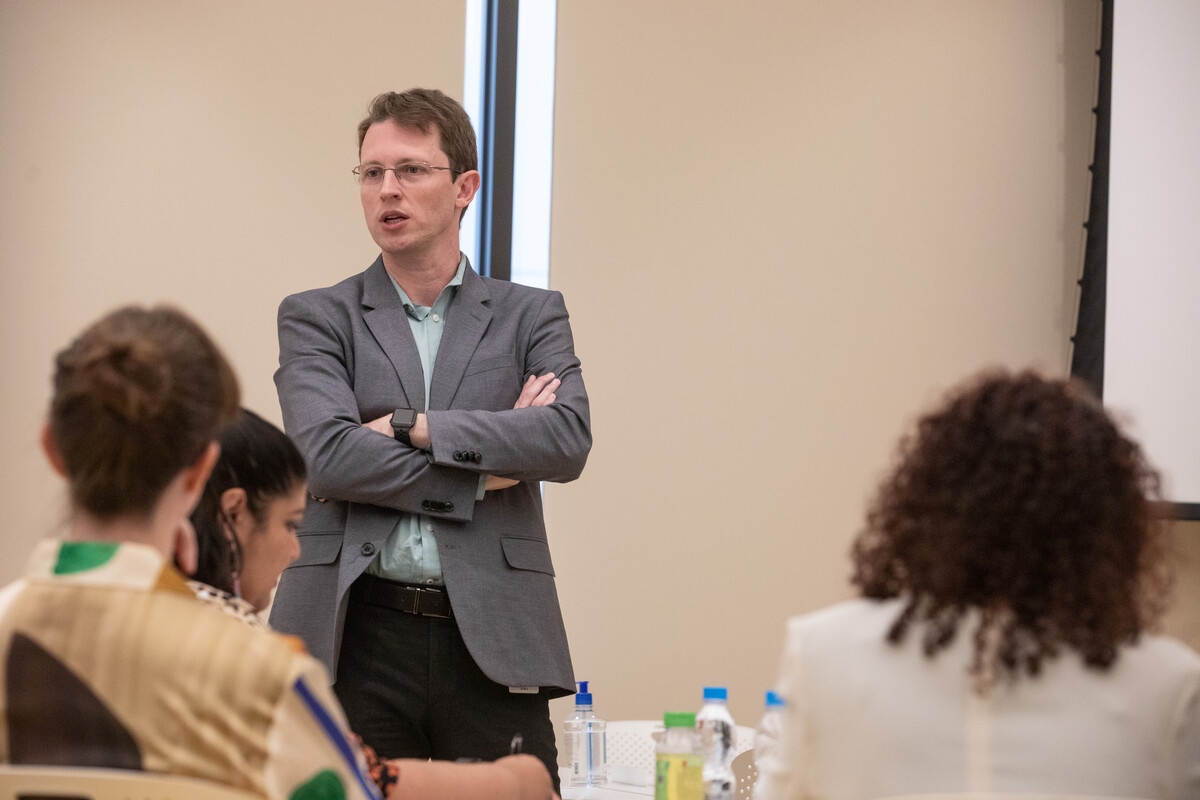 “The academic system often elevates researchers to a position shaped by ego and arrogance, which can undermine leadership,” says biologist Ricardo Weinlich, a researcher at Einstein Hospital Israelita
The traditional path in science—undergraduate research, a master’s degree, a doctorate, and postdoctoral studies—is almost entirely focused on developing technical expertise and publishing high-impact articles.
Yet when researchers assume leadership roles, they encounter an abrupt shift for which the academic system offers little to no formal preparation.
According to biologist Ricardo Weinlich, a senior researcher at Einstein Hospital Israelita, scientists often have to learn “the hard way” how to manage budgets, mediate conflicts, and make strategic decisions.
“There is a significant gap in the training provided for research leaders; they are often ‘thrown to the wolves’ and must find a way to make it work,” said Weinlich, who coordinates a research group dedicated to developing gene therapies using the CRISPR-Cas9 gene-editing technique to treat conditions such as sickle cell disease and epidermolysis bullosa.
Weinlich discussed leadership in research groups during a virtual event organized by Science Arena.
The live session was part of a 2025 series aimed at exploring the future of cutting-edge science and the transformations shaping scientific careers.
In addition to leadership, the series addressed topics such as:
• the impact of AI on scientific careers;
• transitioning from academia to the broader job market;
• interdisciplinary scientific networking;
• strategies for managing stress during graduate training.
Below are the main points highlighted by the researcher:
1. The historical moment and the “turning point”
- The transition from postdoctoral work to leading a laboratory is described as a shock to the system.
- While earlier training is focused on answering scientific questions, the new role suddenly demands skills in people management, project coordination, and financial oversight.
- At the outset, much of this learning happens through trial and error, seeking models in nearby managers or turning to resources outside the academic environment.
2. The challenges and pressures of leadership
- The greatest personal challenge during this transition is insecurity, along with the weight of having other people’s careers and lives under one’s responsibility.
- Unlike the postdoctoral phase, where the consequences of mistakes are largely individual, a leader’s decisions affect the entire group.
- Leadership can also be isolating, creating a sense of distance from the team and requiring researchers to seek support from their peers.
3. Management strategies and the role of the facilitator
- The leader’s role is to act as a facilitator, connecting ideas and people to move research forward.
- It is essential to recognize that a leader should not (and cannot) know more than the collective knowledge of the entire team.
- Decision-making should aim for consensus and include listening to junior members, who may offer innovative perspectives.
4. The importance of the human factor and balance
- Science is part of the formal job market and should be treated as a profession, not merely as a “hobby” or passion project.
- Weinlich acknowledges the difficulty of managing his own time and uses his personal overload as a counterexample for his team, shielding them from excessive stress in order to preserve productivity and mental well-being.
- Successful teams, he argues, value the intellectual capital of all members rather than treating them solely as operational labor.
5. Conflict management and ego control
- The academic system often elevates researchers to positions shaped by ego and arrogance, which can undermine effective leadership, Weinlich observes.
- A good leader must be consistent: if they position themselves as the ultimate authority, the team may replicate that competitive dynamic.
- Conflicts should be addressed directly and individually, encouraging dialogue between those involved before tensions spread throughout the group, he advises.
6. The future of training and mentorship
- The advisor’s role is incomplete if it focuses only on technical training; it must also encompass the student’s broader career development.
- Early-career researchers should proactively seek training in resource and project management, taking advantage of complementary courses available on digital platforms, Weinlich recommends.
7. Strategic vision at the cutting edge of knowledge
- Leading at the cutting edge of knowledge, such as in gene therapy for sickle cell disease and epidermolysis bullosa, requires navigating significant uncertainty.
- Strategic leadership involves freeing the principal researcher from day-to-day operations so they can anticipate societal shifts and secure long-term funding for the group, Weinlich explains.
- Disruptive ideas should be prioritized, even when they require reallocating financial and human resources.
*
This article may be republished online under the CC-BY-NC-ND Creative Commons license.
The text must not be edited and the author(s) and source (Science Arena) must be credited.