 #Suggested Reading
#Suggested Reading
06.11.2025
Authors propose new perspective on dialogue between different knowledge areas
Newly published work seeks to reexamine the connection between different forms of knowledge based on the concept of “partial overlaps”
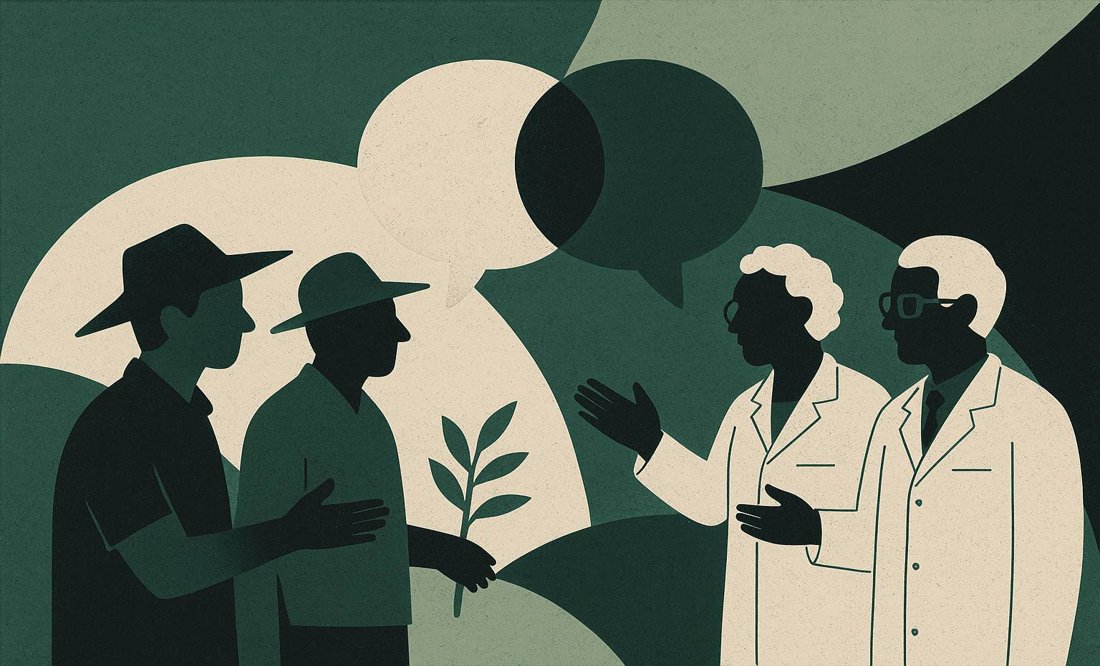 Book by David Ludwig and Charbel N. El-Hani discusses the biggest challenges of transdisciplinarity and proposes a new, philosophy-based method of connecting different knowledge systems to address global crises | Image generated by AI
WHAT DO WE RECOMMEND?
The book Transformative Transdisciplinarity: An Introduction to Community-Based Philosophy, by David Ludwig and Charbel N. El-Hani (Oxford University Press, 2025), in which they propose an innovative approach to thinking about and practicing transdisciplinarity as a transformative process that brings together philosophy, science, and community action.
WHY IS THIS BOOK RELEVANT?
Transformative Transdisciplinarity, by David Ludwig (Wageningen University, Netherlands) and Charbel N. El-Hani (Federal University of Bahia – UFBA, Brazil), proposes a profound reconfiguration of the relationships between science, philosophy, and society. The book criticizes traditional transdisciplinary approaches, which seek to integrate different forms of knowledge from a perspective dominated by academia, reducing other knowledge systems solely to what is considered acceptable to academics.
The authors show that collaborations between scientists, indigenous peoples, and local communities require engagement with different values, knowledge areas, and power dynamics. For Ludwig and El-Hani, transformative transdisciplinarity confronts the inequalities between different forms of knowledge and their users.
WHAT MAKES THIS WORK ESSENTIAL READING?
The main innovation of the book lies in the methodology of partial overlaps, which seeks to identify shared perspectives between different knowledge systems without losing sight of their differences. In doing so, it promotes dialogue and collaboration among different epistemologies, ontologies, and values, rejecting both the total integration and the radical isolation of knowledge. This approach enables partnerships without erasing cultural differences.
“The main novelty of the book lies in placing the methodology of partial overlaps within a broader philosophical and political context, relating it to the relationships between paternalism, diversity, and epistemic decoloniality,” explains Charbel N. El-Hani, of UFBA.
The book also connects debates on objectivity and epistemic and natural kinds of injustice, exploring the suggestion of partial overlaps to the fullest.
Partial overlaps enable dialogue and joint action between academic and traditional knowledge while preserving epistemological, ontological, and value differences.
Concrete examples
In fishing communities in northeastern Brazil, fishers and researchers come together to discuss species such as the sea bass (Centropomus undecimalis), sharing information on certain classificatory categories, even when they disagree on practical or scientific criteria.
In agriculture, farmers classify some species of agricultural interest as fungi (based on appearance), while scientists consider them to be insects (based on phylogeny).
In joint projects, however, both groups recognize each other’s knowledge to develop pest-control strategies, without having to unify or reconcile their criteria.
Thus, the book shows how it is possible to coproduce knowledge without eliminating conflict—recognizing the transformative potential of difference.
*
This article may be republished online under the CC-BY-NC-ND Creative Commons license.
The text must not be edited and the author(s) and source (Science Arena) must be credited.