 #Essays
#Essays
16.12.2025
Gender equality: when representation transforms career paths in science
Female leadership in research can be fostered through initiatives focused on inclusion, training, and female solidarity across society.
 Necessary sisterhood: across Brazil, groups of women scientists have formed a support network in which they support and empower one another and open pathways for others | Image generated by AI
I believe that experiences gained in one area can serve as a reference for professionals in other areas. For this reason, I see my experiences as a researcher as a potential guide for other professionals.
It is important to recognize that female representation is essential in research, and we are in need of role models.
In general, when people think of a scientist, they often imagine a white man with white hair, but this image does not reflect the diversity of those who actually do science.
This is why, in addition to my scientific and technological work, I am deeply involved in initiatives to promote gender equality in science and technology, areas that I consider essential to the sustainable and inclusive advancement of research in the country.
I have a degree in Chemistry, as well as a master’s and doctorate in Materials Science. I currently conduct research in the field of Nanotechnology, focusing on four main areas: green hydrogen production, solar cell development (particularly perovskite-based cells, which use materials with relatively rare crystal structures), effluent treatment, and biomaterials.
Although, the areas in which I work already present many challenges, without a doubt my greatest challenge is being a woman in a scientific environment that is still predominately male.
It was precisely for this reason—and because of the barriers inherent in science—that I created the Futuras Cientistas (Future Scientists) program in 2012.
Three years ago, the program went nationwide and is now present in all Brazilian states, involving science and technology institutions as well as companies.
The program was established to introduce girls and teachers from public schools to the fields of Science, Technology, Engineering, and Mathematics (STEM).
These fields continue to face a major challenge: the low representation of women, even though women already constitute the majority of graduate students in Brazil.
The Futuras Cientistas program is therefore an initiative aimed at transforming this reality by inspiring, training, and creating opportunities for more women to claim space in science and innovation.
Diversity in Science
Science is diverse andpluralistic, shaped by men and women, by individuals of different ethnicities, and by people from a wide range of backgrounds and life paths. This diversity is what makes it richer and more transformative, and it is also why having women scientists in leadership positions is so important.
This is because female empowerment in scientific research, including in the so-called hard sciences, takes place when women see others in these roles, working and leading research groups, and realize that they, too, can get there.
Representation inspires, opens doors, and transforms possibilities into reality.
In this sense, my own experience can serve as both a reference point and a source of inspiration for girls and women who dream of becoming scientists in a country that still undervalues their presence, whether in laboratories or in companies.
I know that the science pathway can be difficult, especially for us women, but my message to other women is not to give up; today we are no longer alone.
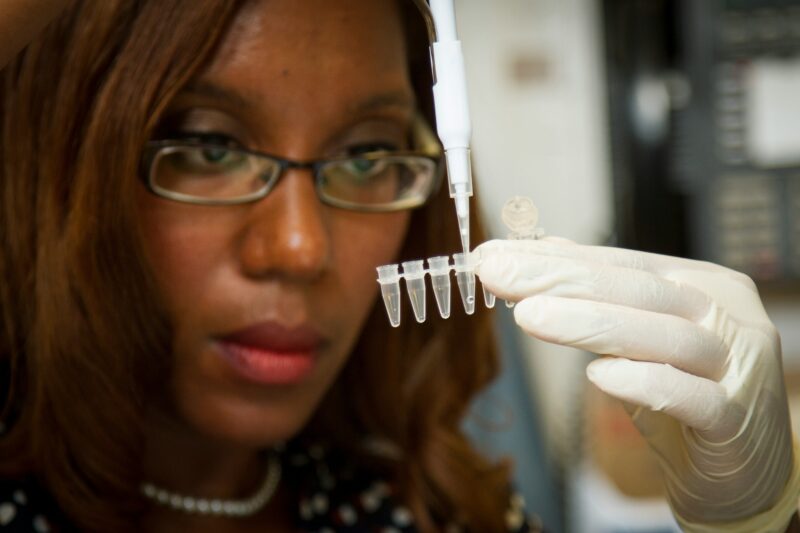
There is a support network formed by groups of women scientists across the country, women who support and empower one another, and open pathways for others.
Female solidarity is necessary, and it has been growing within science. The strength of this network shows that it is possible to resist, persist, and claim space.
So, if I can offer food for thought and some advice to women in a short essay, it would be this: persist in your goals, face challenges, and claim space, because it is worth it.
Seek support, believe in your potential, and keep going, because your place is also in science, where each woman’s trajectory empowers the journey of all women. In this context, female solidarity is essential.
Support networks
No woman is alone on this journey. We are here to support one another, because what we are ultimately seeking is gender equality across society, and science is part of the broader picture.
It is important to remember that gender equality is not only a cause for women, but for society as a whole. Men and women alike need to recognize that a woman’s place is wherever she chooses it to be, including in leadership roles in science and technology.
Science is built on diversity, and it is this plurality of women and men, of people from different backgrounds and perspectives, that enhances a country’s commitment to science and technology for all.
To achieve this, we need to expand opportunities, break down structural barriers, and value female talent at all stages of research, from scientific initiation to leadership.
Gender equality is not just an ethical principle; it is an indispensable condition for the production of high-quality knowledge, innovation, and social transformation.
Women and girls who wish to pursue a scientific career should know that there is space for them, along with support and a network committed to ensuring that their projects flourish. May each one move forward with courage, because their presence is not only welcome—it is necessary.
After all, science reaches its full potential only when everyone can be part of it. The future we seek will be built on diversity, and it begins with the choices we make today.
_
Giovanna Machado is a chemist with a master’s degree and a doctorate in Materials Science from the Federal University of Rio Grande do Sul (UFRGS). A senior researcher at the Northeast Strategic Technology Center (CETENE), she is a member of the Pernambuco Academy of Science and creator of the Futuras Cientistas Program, winner of the Prêmio LED (Luz na Educação [Light in Education Award]) from the Roberto Marinho Foundation. She also received the Women in Action Award in the Social Innovation category (2025), the FACEPE/CONFAP [MG1] Award for Science, Technology, and Innovation in the Innovative Researcher category – public sector (2025), and the Mulher Evidência Nacional Award (National Women of Distinction Award) in recognition of her contribution to a more just and equal society (2024).
Opinion articles do not necessarily reflect the views of Science Arena or Einstein Hospital Israelita.
*
This article may be republished online under the CC-BY-NC-ND Creative Commons license.
The text must not be edited and the author(s) and source (Science Arena) must be credited.