 #Interviews
#Interviews
12.02.2026
“It wasn’t my plan”: One researcher’s journey from academia to the business world
Physicist Amanda Bernardes explains how her academic training paved the way for her work in developing biotechnological solutions in the private sector
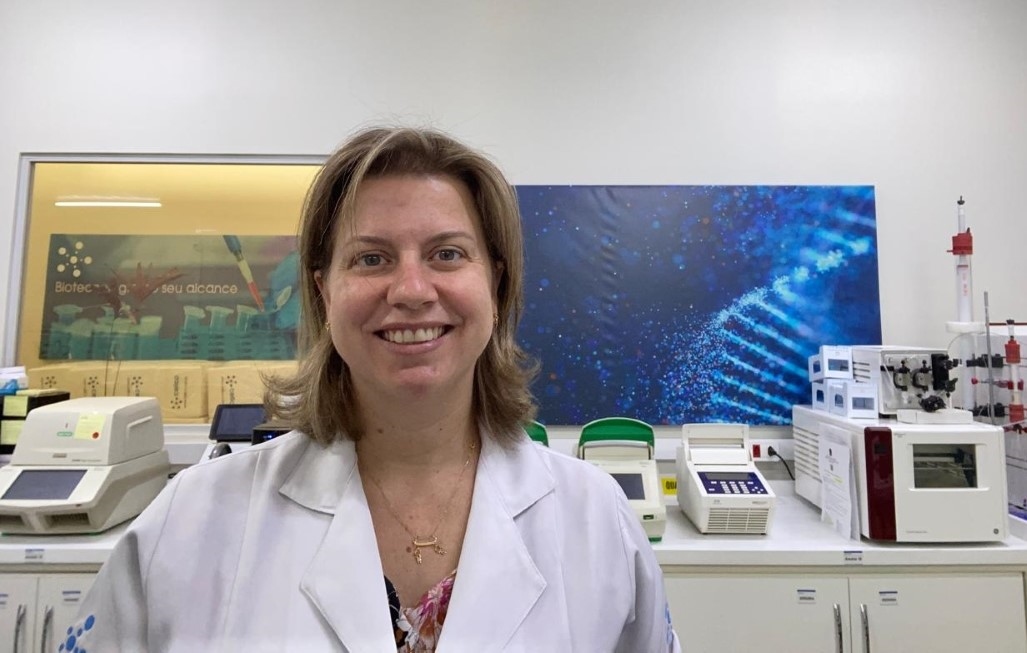 Amanda Bernardes Muniz, of Cellco: “All the knowledge I gained in academia has helped me uphold the rigorous standards of scientific methodology in product development.” | Image: Personal Archive
Amanda Bernardes Muniz, a physicist with a PhD in molecular biotechnology from the University of São Paulo (USP), works as a laboratory manager and protein engineering coordinator at Cellco Biotec. The company was founded by young researchers from USP’s Institute of Physics in São Carlos (SP) and focuses on the development and commercialization of biotechnological solutions.
Cellco has developed high-quality DNA polymerases, which are essential enzymes used in applications such as medical diagnostics. Until 2016, Brazil relied on importing these critical inputs, resulting in high costs and long delivery times—a scenario that created opportunities for new ventures.
During her doctoral studies, Amanda Bernardes envisioned a career in academia, but ultimately found a fertile environment for innovation.
With support from the Innovative Research in Small Businesses (PIPE) program coordinated by the São Paulo Research Foundation (FAPESP), the company began producing enzymes with performance comparable to imported products, offering competitive advantages to the domestic market.
Since 2018, Cellco has supplied the Brazilian market and exported internationally through a partnership with the German company Jena Bioscience, one of the world’s leading manufacturers of reagents for scientific research laboratories.
According to Bernardes, the global market for DNA polymerases generates approximately R$1.5 billion annually, while the modified enzymes segment has already reached US$16 billion.
In an interview with Science Arena, the scientist-entrepreneur reflects on her transition from academia to the business world.
Science Arena – Was working in a company always your goal?
Amanda Bernardes – No, quite the opposite. During my postdoctoral fellowship at USP’s Institute of Physics in São Carlos, I was certain that I wanted to pursue an academic career at a university. But life is full of surprises.
A colleague from my doctoral years had just founded a biotechnology company and invited me to develop an innovation project supported by FAPESP. That was the beginning of Cellco.
I embraced this innovation venture, motivated by the fascinating opportunity to learn how to conduct research from a more business-oriented perspective.
So entrepreneurship was not part of your original plans?
Not even being a researcher, actually. I began my undergraduate studies in physics with the goal of becoming a high school teacher, which is why I pursued a degree in the exact sciences. However, by the end of my first year of college, I decided to dedicate myself to a scientific initiation internship.
Through that project, I became involved in research and development (R&D) focused on molecular biology techniques and protein biophysics. Those nearly four years sparked my fascination with research, led me into academic life, and ultimately motivated me to pursue a direct PhD in biomolecular physics.
How did your academic path develop from there?
My doctoral research involved applying a range of modern techniques and methods in molecular, cellular, and structural biology, with a particular emphasis on proteins.
To expand my expertise and build a network, I completed an internship at a leading center for functional protein assays—the Diabetes and Endocrinology Research Center at the Houston Methodist Research Institute in the United States.
The drive for continuous scientific and professional development, combined with excellent infrastructure, a collaborative work environment, and challenging, stimulating projects, ultimately led me to pursue a postdoctoral fellowship.
During this period, I worked on the production and characterization of protein targets with biotechnological applications, including those related to second-generation ethanol, produced from sugarcane bagasse, straw, and other agricultural residues.
Did you find a supportive environment for innovation and entrepreneurship at the university?
In academia, I was fortunate to be part of an outstanding research group, both in terms of infrastructure and professional and financial support. I consistently received research grants and participated in large-scale projects funded by Brazil’s leading research agencies.
Being surrounded by highly dedicated and skilled professionals, and supported by strong institutional funding, created a positive environment for innovation and entrepreneurship. It was here that Cellco was founded, anchored by former students who emerged from this research environment.
It is also worth noting that I recently completed a specialization in hospital management. This decision was motivated by the company’s growing focus on diagnostic testing and healthcare-oriented solutions.
I wanted to gain a deeper understanding of how hospital systems operate, their clinical routines, regulatory requirements, and management challenges, so that the development of biotechnological products can be increasingly aligned with the real needs of this ecosystem.
I believe that integrating technical and scientific expertise with a strategic understanding of the hospital sector enhances our ability to innovate with purpose and impact.
What were the biggest differences you noticed between academia and entrepreneurship?
From the outset, I observed differences in approach. In academia, my work centered on advancing basic scientific knowledge within a specific field, with outcomes typically measured through publications.
In the corporate environment, objectives are driven by practical demands, focusing on developing processes and products that deliver value to clients and, consequently, to the company.
How does one experience inform the other?
Despite these differing goals, the knowledge I gained in academia has been invaluable in ensuring rigorous scientific standards in product development, even while pursuing results that are faster and more immediately applicable to the company.
Because of its innovative nature, the company retains much of academia’s research-driven mindset, even within a more competitive business environment. For that reason, my transition from academia to industry was smooth and deeply rewarding.
Do you miss the days of basic research?
The company maintains a strong commitment to researching and developing new products, which keeps my scientific curiosity alive, much as it was during my academic career. Of course, differences in priorities bring distinct motivations and skills.
For example?
One of the main differences is working on product development without the support of extensive scientific literature. These are often proprietary products, with confidential processes designed to ensure a company’s competitive advantage.
Even so, the scientific rigor and knowledge I acquired in academia, along with the creativity and resilience it fosters, have enabled me to navigate the absence of established references and develop new processes and products.
Conversely, companies can help academia adopt more practical and adaptable approaches, contributing more directly to solutions for societal challenges.
Both perspectives are essential. When they collaborate, they can significantly advance scientific and technological progress.
Any advice for those considering a transition from academia to the corporate world?
This transition can be challenging, as the underlying interests and objectives are often quite different. However, it is also an excellent opportunity to develop new skills.
I would recommend seeking as much practical experience as possible, through internships, collaborative academic projects with companies, and participation in lectures and workshops, as I did.
These experiences help reveal potential gaps between academic training and market demands, while also providing insight into how the business environment operates and whether that path truly aligns with your goals.
*
This article may be republished online under the CC-BY-NC-ND Creative Commons license.
The text must not be edited and the author(s) and source (Science Arena) must be credited.