 #Interviews
#Interviews
05.03.2026
“Without a control group, we cannot say that polylaminin works,” says coauthor of study on the substance
For neurosurgeon and UFRJ professor Paulo Louzada, flaws in the methodology prevent conclusions about the effectiveness of polylaminin
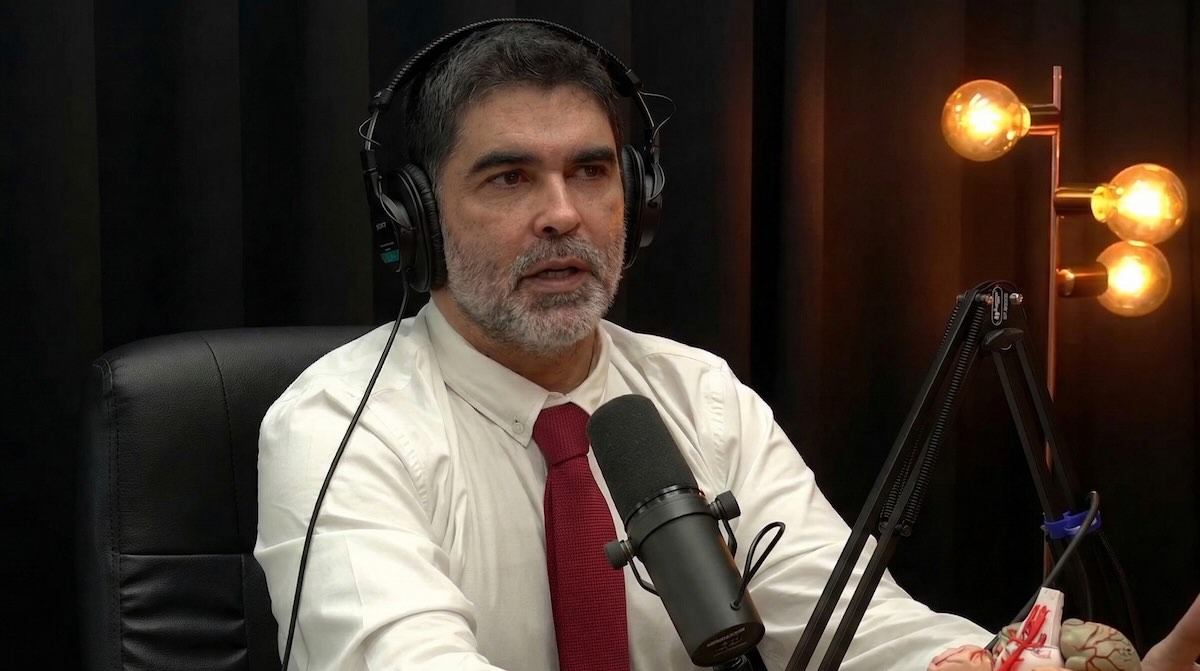 "Pilot studies—especially those without a control group—do not produce scientific evidence," says Paulo Louzada, neurosurgeon and professor at the UFRJ Institute of Biomedical Sciences | Image: Courtesy of Connect Cast
Neurosurgeon Paulo Louzada, a professor at the Institute of Biomedical Sciences at the Federal University of Rio de Janeiro (UFRJ) and coauthor of the preprint on polylaminin (a paper not yet peer-reviewed), occupies a unique position in the debate surrounding the substance that gained national attention in 2025. He belongs to the same research group as scientist Tatiana Sampaio Martins, the study’s lead author, yet does not hesitate to point out the methodological limitations of the study.
For Louzada, the initial phase of the research has limitations that make it difficult to interpret the results reported so far. The most critical issue, he says, is the possibility that some patients received the substance while still in the spinal shock phase, a period of neurological instability that can mask the true diagnosis of the injury.
At least one of the patients may have received the injection less than 24 hours after the trauma, he says. Spinal shock—a phase during which the body may suppress all motor, reflex, sensory, and autonomic activity below the level of the injury—usually dissipates within 72 hours, a window that coincides with the protocol established for the polylaminin injection.
The problem is that during spinal shock an incomplete injury with real potential for recovery may be mistakenly classified as complete. If improvement occurs after treatment, it becomes impossible to distinguish the effect of the substance from the natural progression of the injury.
Louzada also notes that the preprint does not explicitly mention whether the bulbocavernosus reflex test was performed, considered the clinical marker that spinal shock has ended. The paper instead refers to the evaluation of deep anal sensation and voluntary contraction of the anal sphincter, tests that differ from the reflex test itself.
Absence of a control group and confirmation bias
The absence of a control group is another central point of the criticism. Studies indicate that between 10% and 30% of patients with spinal cord injury may show some spontaneous improvement or be reclassified after the acute phase, making a comparison group even more necessary to isolate the effect of the substance being tested.
According to Louzada, the enthusiasm generated by the public attention surrounding the case—along with intense activity on social media and extensive media coverage—increases the risk of confirmation bias, a situation in which researchers may interpret results in ways that support the hypothesis they wish to confirm.
“Scientists must remain skeptical of their own results and always consider the possibility that a finding may have occurred by chance,” he says.
However, the researcher believes the methodological problem is not new. In his view, it existed even before the issue drew national attention and simply became more visible once the data became accessible to the scientific community. Below is an interview with Paulo Louzada for Science Arena.
Science Arena: One of the central points in the debate is the absence of a control group. Is it possible to move on to phases 2 and 3 without a randomized, double-blind control group?
Paulo Louzada: Without a control group and without blinding, we cannot say whether polylaminin works or not. At best, we would remain in the realm of “high probability” or a “strong hypothesis.” No study of a new drug advances to routine clinical practice without a randomized, double-blind clinical trial. One possible exception would be if a statement made by Professor Tatiana on the Roda Viva program [February 23] were confirmed: if 30 patients were able to walk again in a compassionate-use study, this might eliminate the need for a control group. Even then, it would be essential to ensure that the patients were no longer in the spinal shock phase.
The treatment is administered within the first 72 hours after the trauma, a period during which spontaneous recovery may occur. How can the effect of polylaminin be distinguished from the natural course of the injury?
This can be determined by confirming the return of the bulbocavernosus reflex. Once this reflex returns, the neurological examination becomes reliable. If the patient truly has a complete spinal cord injury, the chance of spontaneous recovery—even with traditional treatment such as decompression surgery and physiotherapy—is less than 1%. The likelihood of regaining the ability to walk independently under these conditions, with rigorous confirmation of a complete injury, is virtually zero.
Studies show that between 10% and 30% of patients may experience some spontaneous improvement or be reclassified after the acute phase. How does this affect interpretation of the results?
It is uncertain whether the patients treated with polylaminin were already beyond the spinal shock phase, a detail that does not appear explicitly in the preprint. For this reason, the possibility of spontaneous improvement must be considered in patients who may in fact have had incomplete injuries masked by spinal shock. In my view, the methodological design will need to be reformulated in future applications so that the results can be established with greater confidence.
Is there a risk of observation bias or therapeutic enthusiasm in a context of intense public pressure and high expectations among patients?
Yes. Scientists must remain skeptical of their own results and always consider the possibility that a finding may have occurred by chance. Starting from the premise that the drug may not work helps prevent confirmation bias.
Only well-controlled studies with a larger number of patients will be able to transform a hypothesis into scientific evidence. In my view, methodological bias already existed before the issue gained nationwide attention; it has simply become more visible now that the scientific community has gained access to the data.
The Brazilian Health Regulatory Agency (ANVISA) has authorized only a phase-1 study focused on safety. What would be the minimum criteria for evaluating the effectiveness of polylaminin?
A placebo-controlled, randomized, double-blind study with a larger number of patients would be required.
Can compassionate use and court-ordered decisions compromise the production of scientific evidence?
It certainly can. Court-ordered administration of polylaminin in patients with spinal cord injury—especially when carried out by professionals not trained in the study’s methodology—is a distortion. This type of research should be conducted exclusively by the neurosurgeons responsible for the protocol. When the procedure is performed by professionals not trained in the technique, the risk of errors increases, as does the risk of false-negative results—situations in which the patient might improve but does not because the substance was administered improperly.
*
This article may be republished online under the CC-BY-NC-ND Creative Commons license.
The text must not be edited and the author(s) and source (Science Arena) must be credited.