 #News
#News
#News
05.03.2026
8 strategic applications of AI in medicine
Language models are being incorporated into core areas of care, but a study warns that the technology is still incipient and exposes security and bias risks
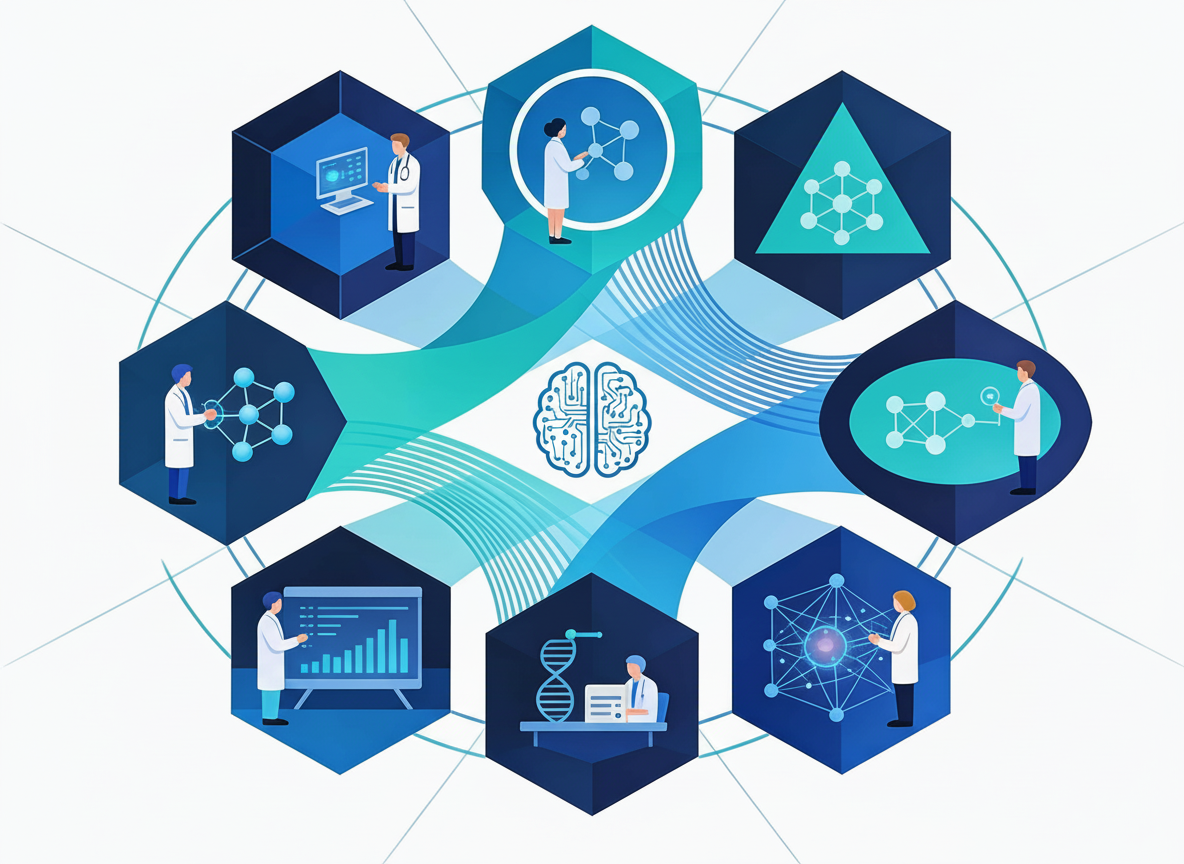 Artificial intelligence is incorporated into core areas of medical care, but technology remains structurally limited | AI-generated image
A pre-print published in September 2025 presents one of the most extensive reviews on the use of large language models (LLMs) in medicine.
The study examined published works indexed in databases such as Web of Science, DBLP, IEEE Xplore, and Google Scholar, mapping the evolution of these technologies between 2020 and 2025—a period marked by exponential growth: from 13 articles published in 2015 to more than 800 in 2024.
The study is authored by researchers from Jinan University and Guangdong Eco-Engineering Polytechnic, both in China, and the University of Illinois Chicago, in the United States. “By analyzing medical data and developing more accurate diagnoses and personalized treatment plans for physicians and other healthcare professionals, LLMs have the potential to revolutionize the healthcare industry,” write the authors.
The potential of AI is bound by three structural limits: the technology is still immature, it carries biases from data used in training, and it exposes privacy and security risks that hinder its adoption in clinical settings.
Limitations of modern medicine where LLMs can help
The study identifies three structural bottlenecks in contemporary medicine that LLMs can help to overcome:
- Fragmented specialization: Medicine is becoming increasingly split into different specialties, facilitating in-depth understanding of specific fields, but also creating knowledge silos. Complex cases require consultations between multiple departments, increasing time and costs and giving rise to communication barriers.
- Limited knowledge and experience: From basic biology to complex diagnostic methods, the knowledge required of physicians is vast and constantly evolving, and when faced with rare and chronic diseases, knowledge gaps can appear.
- Challenges of personalized treatment: Each patient presents unique physical conditions, illness types, and levels of severity. Although doctors offer general recommendations, implementing genuinely personalized care requires individual capacity, which remains limited.
The practical applications reviewed by the authors are described below:
1. Clinical decision support
Synthesizing large volumes of scientific and clinical data, LLMs are being introduced as diagnosis support. Studies have tested models to predict COVID-19 based on written reports of smell and taste losses, and recent research investigates the use of technology in the auxiliary identification of neurological diseases such as Alzheimer’s and dementia.
2. Personalized medicine
AI-based virtual assistants offer guidance on symptoms, treatments and basic care. Their application ranges from recommendations for common conditions—such as colds and flu—to more personalized protocols based on the individual’s clinical history and evolution.
Access via websites, apps, and voice commands extends the reach of this type of care, especially for those who live far from medical centers. “As technology continues to advance, the potential for LLMs to improve care through personalized advice and continuous monitoring is growing, signaling a promising path for modern medicine,” the authors maintain.
3. Medical education
With their text generation and simulation capabilities, LLMs have become useful tools for training professionals. Teachers can create simulated patients to train students in clinical dialogs and rare cases, while virtual platforms allow them to operate fictitious equipment and rehearse procedures prior to performing real interventions. Researchers also benefit from accelerated screening of scientific literature as the technology is used to filter out relevant studies and synthesize key findings, freeing up time for the actual research.
Taken as a whole, these applications support streamlined teaching processes, safer practical training, and a more agile research ecosystem, potentially boosting innovation and the qualification of health professionals.
4. Drug discovery and development
AI is now being applied to chemical structure analysis, compound selection, and safety evaluation protocols. Meanwhile, cutting-edge AI-assisted design of new drugs involves the use of specialized models to generate new molecules from scratch. Recent studies have shown that these approaches outperform traditional models, while techniques such as beam search produce higher quality compounds than sampling methods.
Moreover, integrations with reinforcement learning support dosage and treatment adjustments in simulated environments, potentially leveraging efficacy and reducing adverse effects. In 2021, experiments aimed at identifying protease inhibitors and activity-based probes delivered promising results. Researchers at Amsterdam University Medical Centers are also exploring applications in quantitative pharmacology, an area assisted by LLM-processing of large volumes of scientific literature and clinical data
5. Extraction and updating of medical information
The organization of medical information is being transformed by another application: using deep learning and natural language processing techniques, LLMs scour vast amounts of texts—scientific articles, medical records and reports—and automatically extract relevant information.
They can then quickly construct graphs and dashboards that accurately gather and connect up-to-date clinical data. In oncology, for example, there are already systems that adjust therapeutic recommendations as and when new guidelines are published.
6. Diagnostic imaging
Combined with deep learning, language models have provided advancements in tissue segmentation and lesion identification. Meanwhile, algorithms are being used to reduce noise and improve image clarity in CT scans.
The review includes examples of AI-driven radiomics to predict treatment responses in rectal cancer via MRI, specific models that support breast cancer screening and prevention actions, and tools that extract detailed data on pancreatic lesions from CT and MRI reports.
7. Patient care
In clinical practice, LLMs are already used to answer questions about diseases, treatments and lifestyle habits, improving therapeutic adherence and reducing communication noise. Applied to electronic patient records, they analyze documents, identify gaps and inconsistencies between diagnosis and behavior, and suggest adjustments.
8. Analysis of medical literature
Language models organize the methods, results, and conclusions of articles in structured formats, facilitating quick consultation for physicians. They also classify studies by area, summarize findings, and evaluate indications of robustness, such as citation count and impact factor.
“In a field as dynamic as medicine, continuous updating is essential—and LLMs are helping professionals keep up with the latest advancements and provide evidence-based care,” conclude the authors.
*
This article may be republished online under the CC-BY-NC-ND Creative Commons license.
The text must not be edited and the author(s) and source (Science Arena) must be credited.