 #News
#News
#News
11.09.2025
Polylaminin and pathways toward regenerating the spinal cord
After 25 years of research, a substance developed at UFRJ shows potential to restore movement in patients with complete spinal cord injuries
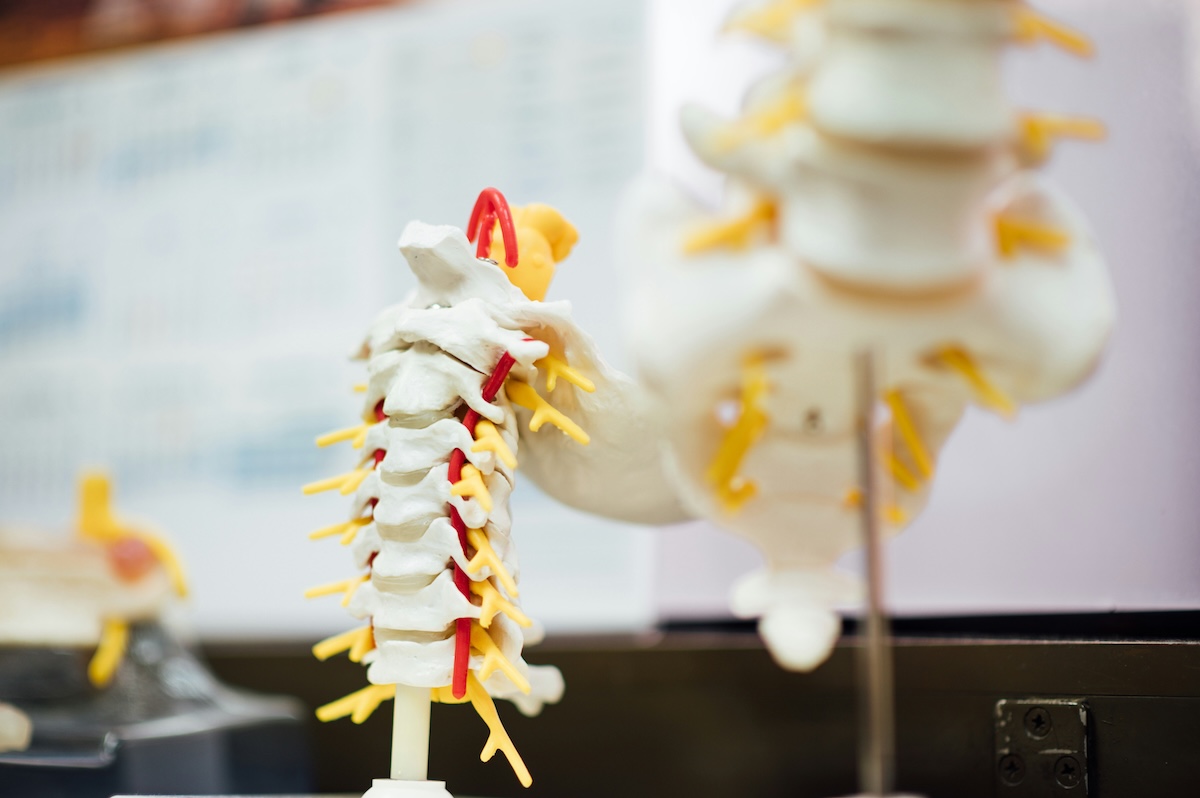 Research with polylaminin aims to regenerate damaged connections in this region after traumatic injuries | Image: CHUTTERSNAP/Unsplash
A substance developed in the laboratory by researchers at the Federal University of Rio de Janeiro (UFRJ) may represent a new paradigm in the treatment of spinal cord injuries—a condition for which conventional medicine still has no truly effective regenerative therapies.
The molecule, known as polylaminin, is a reconstituted form of laminin, a protein essential for the organization of the nervous system during embryogenesis.
By recreating its natural polymeric structure in the laboratory, scientists enabled polylaminin to form a three-dimensional network capable of promoting axonal growth and reestablishing nerve connections.
An unprecedented clinical study
The first results in humans were published as a preprint in medRxiv in February 2024. The study involved eight patients who had sustained complete spinal cord injuries, a condition that historically carries less than a 15% chance of motor recovery without intervention.
Participants received a single intraparenchymal injection of polylaminin an average of 2.3 days after the trauma.
Of the eight volunteers, six survived, demonstrating recovery of voluntary motor contractions below the level of injury—an outcome considered unprecedented in such cases.
Recovery was documented using the International Standards for Neurological Classification of Spinal Cord Injury (ISNCSCI) scale and evoked potentials.
Bruno Drummond, a participant who was left quadriplegic after a car accident, was among the first to show improvement.
Consistent evidence in animal models
Before advancing to human trials, the researchers gathered a robust body of experimental evidence. In an article published in Frontiers in Veterinary Science (2025), the team tested the substance in paraplegic dogs with chronic injuries.
The results indicated significant functional improvement, particularly when combined with adjuvants such as GDNF (glial cell-derived neurotrophic factor) or chondroitinase ABC, which breaks down the scar matrix.
Previous studies in rodents had also shown that the substance reduces inflammation, limits tissue loss, and promotes axonal regeneration across multiple models of spinal cord injury.
Regulatory and scientific obstacles
Despite the excitement, the transition from laboratory research to clinical use faces several barriers. Cristália, a Brazilian pharmaceutical company and partner in the development, is awaiting authorization from Brazil’s health regulatory agency ANVISA to begin phase-2 clinical trials in public hospitals in the state of São Paulo.
ANVISA states that additional data from preclinical studies are still required, particularly regarding pharmacological stability and reproductive safety.
“These studies are essential in determining whether the product can proceed to the next phase of testing in humans,” the agency said in a statement sent to news outlets.
Polylaminin appears to be most effective when administered within 72 hours after trauma. Its impact on chronic or degenerative injuries still needs to be evaluated in wider studies.
In addition, a full understanding of its action mechanism—whether it depends solely on the structure of the extracellular matrix or also involves direct cellular modulation—remains under investigation.
-
What is laminin?
-
Laminin is a fundamental protein of the extracellular matrix, especially abundant during embryonic development. It functions as a biological “scaffold,” promoting cell adhesion, neuronal growth, and the formation of connections between cells in the nervous system. In adults, its presence is far more limited and it rarely appears in injured areas of the central nervous system.
-
How is polylaminin produced?
-
Polylaminin is a polymeric and stable form of laminin created in the laboratory from proteins extracted from the human placenta. The process was developed by scientists at UFRJ, who succeeded in recreating laminin’s natural structure, enabling it once again to form three-dimensional networks similar to those present during fetal development.
-
Who can benefit?
-
Initially, polylaminin treatment was tested in patients with acute complete spinal cord injuries—that is, those with total loss of movement and sensation following trauma—treated within six days of the accident. In animal studies, some benefit has also been observed in chronic cases when combined with adjuvant therapies. However, further studies are needed to define its effectiveness at different stages and in different types of injury.
-
What is the role of the placenta?
-
The placenta is a rich source of laminin, particularly during pregnancy. As a temporary organ connecting the fetus to the mother’s uterus, it contains high concentrations of proteins that promote cell growth and differentiation. Scientists extract these proteins to manufacture polylaminin—taking advantage of an abundant biological material that would normally be discarded after childbirth.
*
This article may be republished online under the CC-BY-NC-ND Creative Commons license.
The text must not be edited and the author(s) and source (Science Arena) must be credited.