 #Suggested Reading
#Suggested Reading
19.03.2026
A six-million-year story that explains why we speak
A cognitive archaeologist pieces together the evolutionary puzzle of human language, while a monologue by Gregório Duvivier complements the experience
 Cognitive archaeologist Steven Mithen’s book brings together 15 pieces of a puzzle to tell the story of how language emerged in hominins—from vocal anatomy to the symbolic explosion of Homo sapiens | Image: Unsplash
WHAT DO I RECOMMEND?
I recommend both a book and a monologue—each addressing the same theme: language. The book is The Language Puzzle: Piecing Together the Six-Million-Year Story of How Words Evolved, written by the cognitive archaeologist Steven Mithen, who has a special interest in linguistics, and published by Basic Books (New York) in 2024.
The book finds an echo in Brazilian art in the form of the monologue O céu da língua (The sky of language), by Gregório Duvivier, which was performed in São Paulo. I first read Mithen’s book and then watched Duvivier’s monologue; he has also written a short booklet that can be purchased after the performance.
WHY IS THIS TEXT RELEVANT?
Mithen adopts an engaging strategy to explain how words emerged and evolved in hominins. He begins by outlining the current state of knowledge on how species of the genus Homo—including us, Homo sapiens—developed these abilities. He then delves into the puzzle, presenting 15 pieces that help us understand how language may have emerged in our ancestors and led us to our current stage, in which we use metaphors and communicate in complex ways.
Among the pieces are questions such as how words originated, whether other apes also speak, whether Neanderthals spoke, whether tools and fire contributed to the development of speech, how speech influences thought, how we became symbolic beings, and how speech relates to this. After laying the pieces “on the table,” Mithen elaborates, in the final chapter, on his view of what our history might have been. No, this is not a spoiler.
The book needs to be read to be fully appreciated and can be approached in different ways. Those who only want a taster, without the finer details of each piece, can read just the concluding chapter. Readers who wish to understand the individual pieces can read the book without consulting the citations. And for those like me who enjoy science, it is well worth reading each of the references—of high scientific quality—that support the soundness of the arguments. At certain points, the author even indicates whether he agrees or disagrees with a given reference he cites or whether he prefers a particular theory. The primary language addressed in the book is, of course, English, and for those familiar with the language, it is a pleasure to gain an even deeper understanding of the origins of expressions and their transformations over time.
In my recommendation I have also included Duvivier’s monologue because it draws, to some extent, on Chapter 3 of Mithen’s book and other excerpts as the basis for his play, which addresses the Portuguese language. The monologue is delightful on its own, but it becomes even richer when experienced after reading Mithen.
WHAT MAKES THIS TEXT A MUST-READ?
For those who want to understand how our species arrived at its current stage, understanding how and why we speak is essential. Even though I have read several books on linguistics, I still learned some interesting things from Mithen.
For example, the development of our anatomy—our vocal and auditory systems—is fundamental to speech. Our rounded brain and enlarged prefrontal cortex distinguish us from other Homo species with which we coexisted.
One of the most striking ideas, in my view, is that only with the emergence of Homo sapiens did neural networks begin to communicate internally, leading to an explosion of connections and enabling monologues, such as Duvivier’s, which captivate audiences through art. Mithen and Duvivier help us better understand why we are called sapiens.
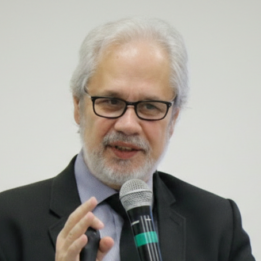
Marcos Buckeridge é professor titular do departamento de botânica na Universidade de São Paulo. Foi diretor do Instituto Nacional de Ciência e Tecnologia do Bioetanol (INCT Bioetanol de 2008 a 2025) e hoje é coordenador da mesma organização.
Opinion articles do not necessarily reflect the views of Science Arena or Einstein Hospital Israelita.
*
This article may be republished online under the CC-BY-NC-ND Creative Commons license.
The text must not be edited and the author(s) and source (Science Arena) must be credited.