Mezzo-soprano and scientist: how Renata Prôa built an international research career
A PhD candidate at Columbia and data scientist at Einstein, Prôa argues that young researchers need to learn to better communicate their career paths
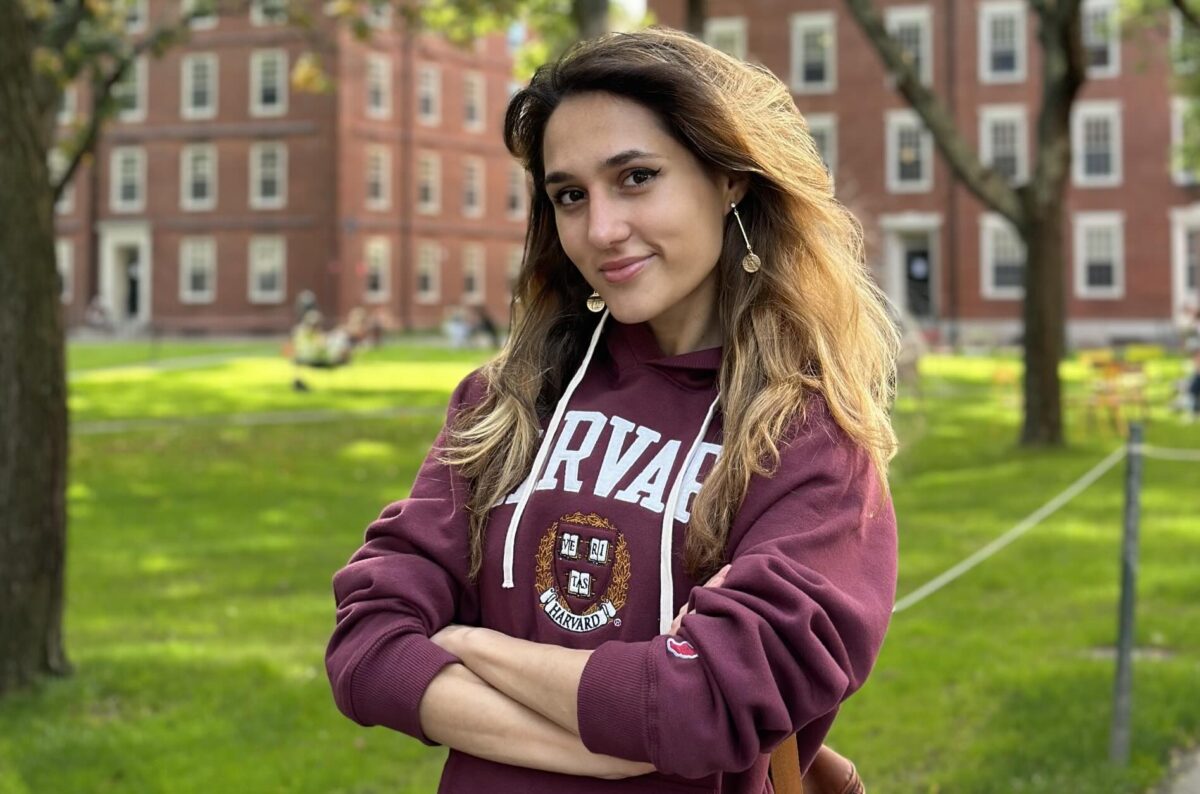 “You can be brilliant, but if you don’t know how to tell your story, you will never achieve your goals,” says Renata Prôa, a data scientist at Einstein Hospital Israelita | Image: Personal Archive
“You can be brilliant, but if can’t tell your story, you’ll never achieve your goals.” In a single sentence, this quote sums up a principle that Renata Prôa has transformed into a method. The Einstein Hospital Israelita data scientist, 25, is currently pursuing a PhD in theoretical neuroscience at New York City’s Columbia University—a path that also included a master’s degree in public health at Harvard University, completed during a year-long sabbatical from her doctoral program.
Prôa was born in São José dos Campos, São Paulo State, and earned a degree in molecular sciences from the University of São Paulo (USP). She also trained as a mezzo-soprano singer at the Academy of the São Paulo Symphony Orchestra (OSESP), where she first began combining her love of music and science.
At Einstein, Prôa has focused on developing solutions for Brazil’s public healthcare system (SUS), especially disease-screening algorithms and models that combine climate and health data to predict how environmental changes impact vulnerable populations.
In this interview with Science Arena, she discusses her route into international academia, data biases in artificial intelligence (AI), and what science still needs to do to better connect with the general public.
The first chords
With experience in mathematics and neuroscience, Prôa joined Einstein Hospital Israelita—while still an undergraduate in molecular sciences at USP—to study dystonia, a neurological condition common among musicians.
The overlap between disciplines was no accident: from the very start, she sought to explain the brain through mathematical models—she had an almost philosophical drive to translate emotions and perceptions into equations.
Music was never merely a backdrop in that journey. While studying for her degree in molecular sciences, Prôa was also a professional singer and mezzo-soprano with OSESP.
While observing an orchestra in Germany, she gained insights that would later become central to her mathematical models.
“Many of my ideas came from artistic references. Artists have a willingness to question the obvious, which is essential to science,” says Prôa.
It was also at Einstein that she discovered a new direction for her work: understanding the direct impact of scientific research on public health. Working first with neuroimaging and later with AI applied to medical imaging, she realized she could shorten the distance between research and real life.
“I fell in love with seeing science reach people,” she says.
Since then, her work has focused on developing solutions for Brazil’s public health system (SUS), including disease-screening algorithms and models that combine climate and health data to predict the impacts of environmental changes on vulnerable populations.
Going global
Prôa’s international career was not something she planned since childhood. It emerged, she says, from her active desire to understand the global academic system.
In 2022, she began a PhD in theoretical neuroscience at Columbia University, New York. After completing her second year—at which point the program automatically grants a master’s degree—she took a one-year leave of absence to pursue a master’s in public health at Harvard. She completed the program in May 2025 and resumed her doctoral studies at Columbia the following semester.
The decision, seemingly unconventional at first glance, stemmed from a realization Prôa had during her PhD. While working on projects for SUS, she noticed that the results had a more tangible and immediate impact than her original line of research involving mathematical models of the brain.
The shift was not between fields, but between scales: from the laboratory to the healthcare system. To ensure she could maintain the same technical quality in this new area, she concluded that she needed training in public health and strategic management. Harvard provided exactly that.
The transition she made is reflected in the work she is now doing at Einstein, through initiatives combining AI, climate, and equality within SUS.
A turning point came in 2021, before she had even started her PhD, when she joined the Próxima Initiative, a Yale University mentoring program for young scientists in the biomedical sciences.
For a year, Prôa was mentored by a Yale neuroscience PhD student who guided her through the application process, from understanding the international academic system to the emotional challenge of writing a personal statement.
At Columbia, she found herself as the only student in her class from outside the elite circles of American higher education, which further motivated her to participate in mentoring programs.
One of the biggest challenges was writing her personal statement, an essay in which candidates have to present themselves confidently. Prôa says she had to overcome what she describes as a “Brazilian culture of humility,” as well as impostor syndrome, both of which made it difficult for her to talk confidently about her accomplishments.
Her discomfort with self-promotion, which she believes is something cultural rather than individual, eventually became the basis for a separate communication project.
With over 30,000 Instagram followers, Prôa now advises young researchers interested in studying abroad, sharing what she has learned about international applications, interdisciplinarity, and academic careers.
The initiative took shape during her master’s degree at Harvard, where she worked as a science communicator for the institution. The response has been especially positive among Brazilian students who do not have access to structured support networks.
Science without a pedestal
When discussing AI—a central theme of her current work—Prôa is careful to avoid blind enthusiasm. For her, the importance of the technology lies less in its technical sophistication and more in what people are using it for.
In a country marked by inequality, this means ensuring diagnostic algorithms work across different patient populations.
“AI is an extremely powerful automation tool. The big risk is the biases in the data,” says Prôa.
“When you train a model using data from only one group, it will not work for others,” she explains. She also stresses that academia needs to learn to engage with the general public, to welcome questions and step down from the pedestal that distances knowledge from the public.
For those just starting out, her advice is straightforward: “Don’t be afraid to ask questions—there are no stupid ones. And perhaps most importantly, recognize that science is neither a solitary nor a linear path. Results alone are not enough. Science involves communication, human relationships, and politics. Having a support network makes a huge difference.”
How to apply to universities abroad
-
1. Master English, but go beyond it
-
Proficiency in the language is the minimum requirement. The real challenge is understanding the admissions culture in each country, which can differ significantly from the Brazilian process.
-
2. Seek out mentorship programs
-
Programs like the Proxima Initiative provide guidance from people who have already been through the process. Structured support networks make a real difference, especially for students outside elite university circles.
-
3. Invest in your personal statement
-
Application essays require candidates to clearly advocate for their own achievements. Brazilian students often need to overcome a “culture of humility” and impostor syndrome to confidently present their academic experiences.
-
4. Follow an interdisciplinary path
-
American universities place a high value on working across different fields. A background in mathematics applied to neuroscience, for example, can be a more compelling differentiator than a linear résumé.
-
5. Communicate your science
-
Knowing how to do research is not enough. It is important to know how to explain what you are doing—to assessment committees, funding agencies, and the wider public. Scientific communication is an integral part of the career, not an afterthought.
*
This article may be republished online under the CC-BY-NC-ND Creative Commons license.
The text must not be edited and the author(s) and source (Science Arena) must be credited.