 #Interviews
#Interviews
06.01.2026
Applying science to a nation’s most urgent challenges
Karin Herrera, vice president of Guatemala, discusses how scientific training guides public decision-making in a country with marked inequalities
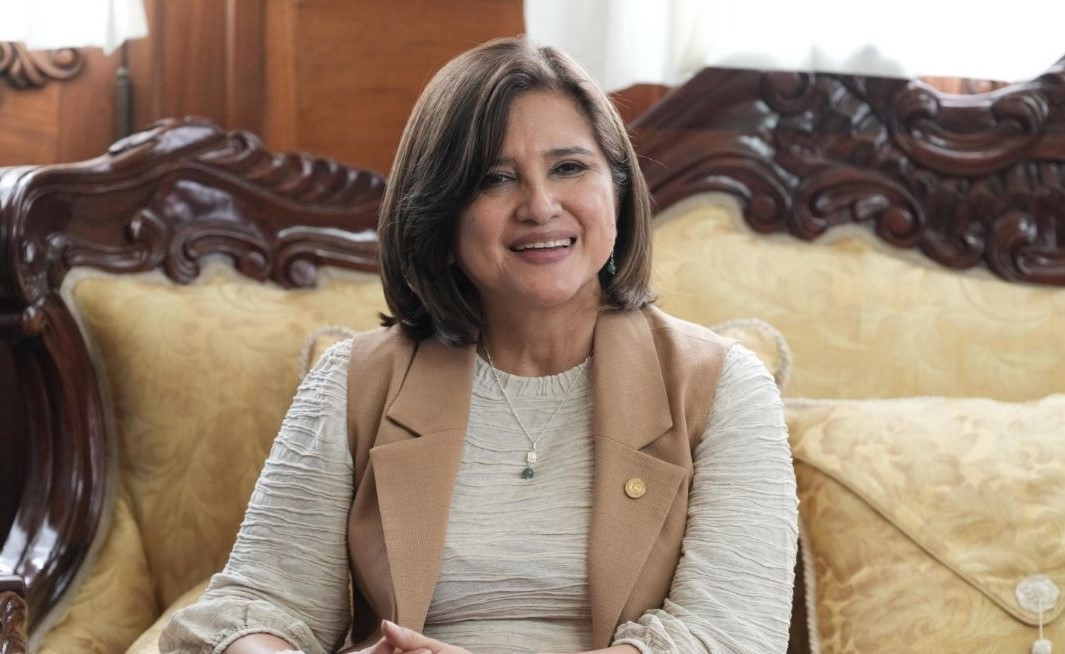 Microbiologist Karin Herrera, vice president of Guatemala: "Data and numbers need to translate into real improvements in quality of life" | Image: Vice President’s Office, Guatemala
Science must not remain confined to the laboratory when people are in need of practical ways to improve their quality of life. This statement by Karin Larissa Herrera Aguilar summarizes the central theme of the conversation held between the microbiologist and current vice president of Guatemala and Science Arena last October.
During a visit to Brazil* to participate in the 17th General Conference of The World Academy of Sciences (TWAS) in Rio de Janeiro, Herrera emphasized the role of scientific knowledge in formulating public policies capable of tackling social inequality, environmental crises, and structural challenges such as chronic malnutrition.
Herrera is a career scientist with a bachelor’s degree in biological chemistry from the University of San Carlos in Guatemala (USAC), a master’s degree in environmental studies, and a PhD in sociology from the Pontifical University of Salamanca, Spain.
Before becoming vice president of the Central American country, for a term that ends in 2028, Herrera spent more than three decades in the public higher education system.
She worked as a professor, researcher, and academic administrator at the School of Chemical Sciences and Pharmacy, the only public higher education institution in Guatemala. Her research focused on topics such as microbiology, water quality, environmental health, and science education.
In the interview below, Herrera reflects on her transition from academia to politics, explaining that issues such as food security, access to education, climate risks, and international cooperation require close collaboration between science, the State, and society.
Science Arena – You have built a solid career in science, with decades of academic work. When did you decide to enter politics, and what motivated this transition from microbiology to public administration?
Karin Herrera – I began my education at Guatemala’s public university, where I completed my undergraduate degree, and then I did my master’s and PhD at private institutions. I then worked at the public university for over 30 years, which led to my voluntary participation in various government bodies linked to academia.
My involvement with the National Council for Food and Nutritional Security in 2017 was a turning point. It became very clear to me that there was a major gap between the research conducted at universities and scientific institutions and what actually happens at government agencies.
I realized that with better coordination, research could more directly guide the formulation of evidence-based public policies and regulations.
At the same time, the public higher education system was facing major crises. I felt limited, unable to drive the necessary structural changes from within academia itself. It was against this backdrop that I was invited to join Bernardo Arévalo’s presidential ticket.
I did not go in with any certainty that we would win, but I knew that if we did, I would be there because of my commitment to issues that have always motivated me, namely science, education, and development.
Your education is noticeably interdisciplinary: you are a biologist with a PhD in sociology, and you have worked in fields such as microbiology, the environment, and health. How important was this to your scientific and political career?
It has been crucial. During my master’s degree, I analyzed water quality in regions such as the Polochic River basin and Petén. When we presented our results, we noticed that there was interest from politicians, fisherpeople, and civil society representatives.
But we were talking in very technical terms—bacteria, nitrates, phosphates—without answering their practical questions.
I will never forget the words of one local politician, who said, “I only have the resources for one treatment plant. Where should we build it? Which area is most polluted?” That was a warning.
I was too focused on the technical diagnosis and not paying enough attention to people’s real needs.
It was this incongruence that led me to pursue a PhD in sociology. I continued studying water quality, but I started looking at the problems from the perspective of people, social risks, and decision-making with limited resources.
My interdisciplinary experience has taught me how to prioritize and helped me understand that data and numbers need to translate into real improvements in quality of life.
Today, as vice president of Guatemala, this perspective is even more essential. We are dealing with issues that were not even on the radar before, such as migration and human trafficking, but the logic is the same: policies need to have goals, indicators, and mechanisms for monitoring and evaluation so that they can be adjusted and improved over time.
Five key ideas from Karin Herrera’s career path
-
The transition from science to politics
-
Herrera’s move into politics arose from her realization that there was a persistent disconnect between scientific research being conducted at universities and government decisions. Her experience on government panels helped her see that public policies lack alignment with scientific evidence and with the real needs of the population.
-
Interdisciplinarity for more effective public decision-making
-
Herrera’s career path, which combines microbiology, environmental studies, and sociology, broadened her perspective beyond the laboratory; her interdisciplinary experience has enabled her to prioritize scarce resources, translate technical data into practical decisions, and include social, economic, and human dimensions in policy-making processes.
-
Evidence-based public policies
-
Herrera advocates for clear goals, indicators, and continuous evaluation as essential pillars of public administration. The biggest obstacle, she says, is not technical, but cultural: not all government sectors are accustomed to making use of monitoring, evidence, and systematic adjustments to implemented policies.
-
Science connected to people and social inequality
-
This interview emphasizes that scientific data can only have an impact when they translate into concrete improvements in quality of life. Food security, education, access to water, migration, and chronic malnutrition are complex problems that require active listening, horizontal dialogue, and solutions developed together with communities.
-
Strengthening scientific infrastructure
-
Herrera highlights efforts to expand international partnerships, researcher mobility, and knowledge exchange, while also acknowledging the fragility of Guatemala’s science infrastructure. Her goal is to bring together universities, research centers, and the government through an integrated vision of science-based development.
You are often outspoken in support of evidence-based public policies. What are the main challenges to implementing this approach in Guatemala’s public administration?
The biggest challenge is cultural. Not everyone is used to working with clear goals, indicators, and continuous evaluation. But it is a change that needs to be made. When policies are formulated based on evidence, we can demonstrate what works and what needs to be adjusted.
There are major inequalities in access to education in Guatemala. Coverage of secondary and higher education is very limited, which directly impacts our ability to develop as a nation.
To create a basis for sustainable and integrated development, we need to strengthen education and address structural issues such as food security and chronic malnutrition.
How does your scientific experience influence the way you engage with the public and different sectors of society?
I learned that we need to listen more. When I first started interacting directly with communities, I noticed a high level of distrust, stemming from historical issues. This is not something that can be fixed overnight.
It is essential to show genuine interest, act respectfully, and not impose solutions—the dialogue needs to be horizontal. All people have the same rights and they need to feel that they are part of the process. That is the only way to build trust and advance policies that truly meet their needs.
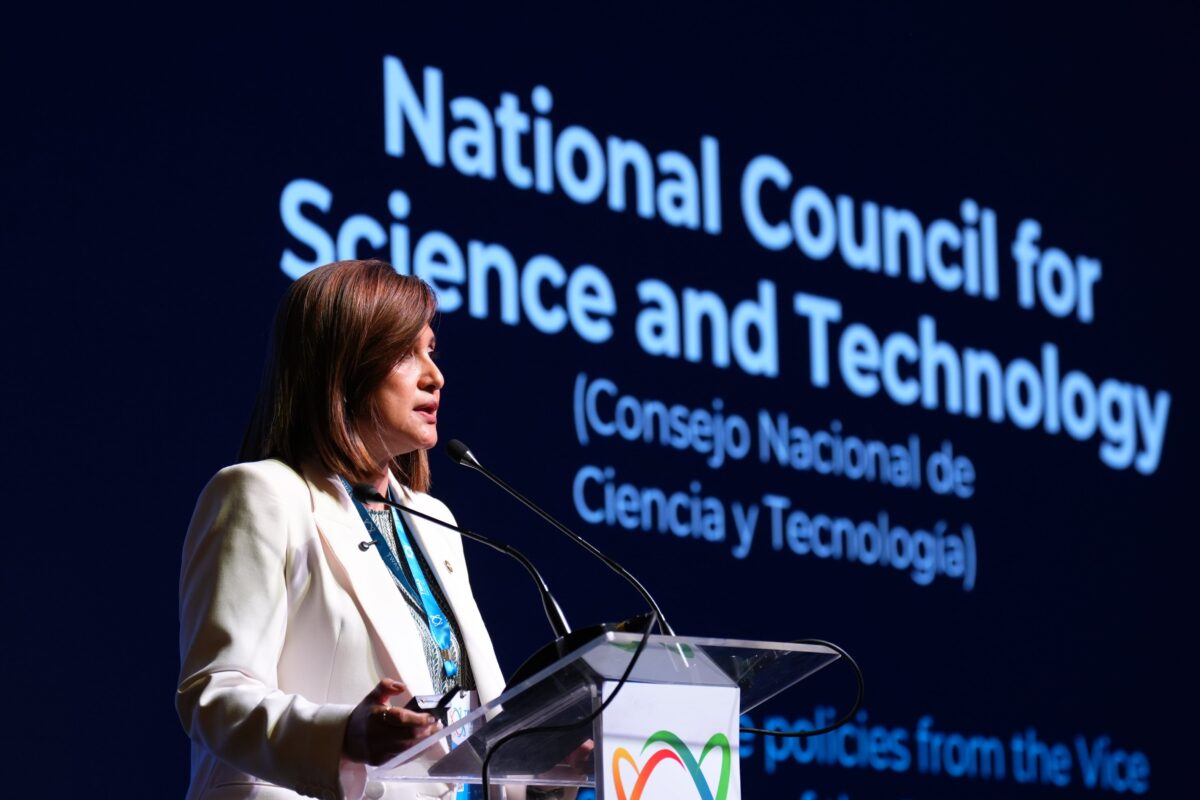
What efforts is the Guatemalan government making to strengthen the country’s scientific infrastructure and expand international collaborations?
From my position as vice president, I have strived to use bilateral meetings to place science at the center of international dialogue. I strongly advocate for researcher mobility, scholarships, and knowledge exchanges, based on the principle that our professionals may leave, but they may also return to the country.
We have held discussions with institutions such as the Center for International Cooperation in Agronomic Research for Development (CIRAD) in France and the European Space Agency (ESA) about the possibility of establishing research centers in Guatemala to monitor climate risks, food security, and social vulnerability.
At the same time, we know that we need to invest more in scientific infrastructure. That remains a major challenge.
My dream is for Guatemala to adopt an integrated national vision in which universities and research centers work together, despite our limited resources.
And what role can science play in tackling structural problems such as chronic malnutrition?
Malnutrition is not only about food. It is also related to poverty, access, quality, and integrated policies. I am convinced that science can and should offer solutions to these problems.
If necessary, we will go to universities and consult with nutritionists, doctors, agronomists, and engineers who can help by carrying out research into these issues.
Connecting the academic sector to the real needs of the population is essential to promoting fairer development.
Finally, what message would you offer to young researchers interested in working at the intersection of science and public policy?
I would say do not be afraid of interdisciplinarity. Science does not end in the laboratory or with the publication of articles. When connected to society’s needs, it becomes a powerful tool for transformation. We need scientists willing to engage in dialogue, to listen, and to develop solutions together with the people.
*The Science Arena team was invited to Rio de Janeiro by TWAS.
*
This article may be republished online under the CC-BY-NC-ND Creative Commons license.
The text must not be edited and the author(s) and source (Science Arena) must be credited.