 #News
#News
#News
04.06.2026
Frontier science takes risk, but Brazil still punishes failure
Experts say that truly innovative projects require safer environments in which to make mistakes, recombine knowledge, and challenge paradigms
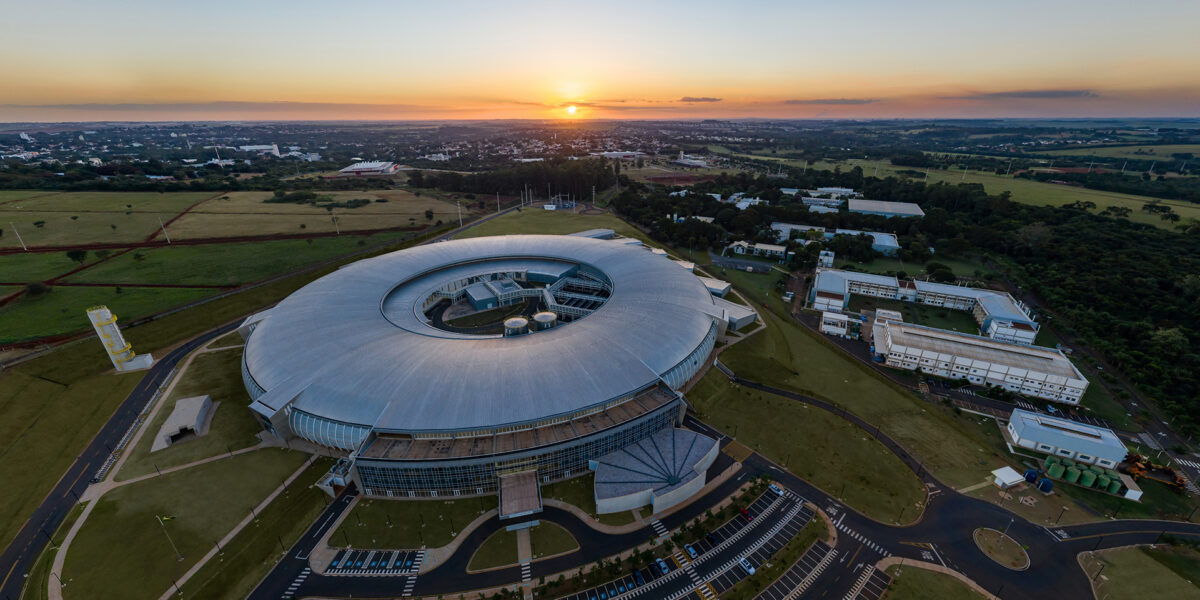 Aerial view of Sirius, the particle accelerator operated by the Brazilian Center for Research in Energy and Materials (CNPEM) in Campinas, São Paulo state—one of the first fourth-generation particle accelerators in operation worldwide | Image: Brazilian Synchrotron Light Laboratory
The frontier of knowledge is a moving target. What is unknown today may become known tomorrow—a sign that science has advanced. But for that to happen, the research system must accept risk and failure, both of which are inherent to any process trying something genuinely new.
One of the defining characteristics of frontier science is recombination, says Adriana Bin, who holds a PhD in science and technology policy and is a researcher at the University of Campinas (UNICAMP). “I’m referring to the combination or recombination of things that already existed but have not yet been brought together: different theories, different methodologies, different approaches.”
In science, it is generally the scientific community itself that defines this frontier. “The scientific community itself—the peers—is responsible for organizing and defining what constitutes the scientific frontier,” says Sérgio Salles-Filho, also a researcher at UNICAMP and a scholar of science policy.
The conservative bias of peer review
This same group that defines the frontier is also responsible for evaluating research proposals, which can create challenges. “The issue is not exactly risk aversion, but rather a conservative bias that peers tend to adopt when assessing more innovative proposals,” Bin says.
Reviewers may reject proposals that challenge established paradigms, especially when they cross disciplinary boundaries and fall outside traditional, well-established evaluation criteria.
The result is a system whose structure often penalizes risk-taking. The evaluation metrics used by Brazil’s Federal Agency for Support and Evaluation of Graduate Education (CAPES), the country’s leading postgraduate assessment body, emphasize quick results and measurable impact. Projects with significant innovative potential, but also a greater likelihood of failure, do not always receive favorable evaluations.
“Tolerance for failure must be built into the way agencies fund this type of research. It may succeed, but it may not. At present, Brazilian funding agencies generally do not operate with that mindset,” Bin explains.
The system, however, is not monolithic. There are openings. One of them has a circumference of 518 meters and is located in Campinas. Sirius, one of the first fourth-generation particle accelerators to enter operation worldwide and the brightest in its energy range, is operated by CNPEM in Campinas. It represents a rare example of frontier scientific infrastructure built in Brazil.
According to CNPEM director-general Antônio José Roque da Silva, the project was made possible because it was conceived from the outset with a willingness to do what had never been done before in the country. That required developing and inventing solutions along the way, at the cost of mistakes and setbacks. For him, the central issue is how the surrounding environment responds to those challenges.
“You need an environment in which people are willing to push toward the frontier and feel confident that they will not be penalized for making mistakes,” says José Roque of CNPEM.
Brazil’s distinct frontiers in health research
In the health sector, the challenge takes on an additional dimension. “Health research in Brazil has frontiers of knowledge that differ from those in the rest of the world,” says Fernanda De Negri, secretary of Science, Technology, Innovation, and the Health Economic-Industrial Complex (SECTICS) at Brazil’s Ministry of Health. In her view the country must address both global challenges and problems specific to its own population.
Currently being structured within SECTICS, the Radical Pharmaceutical Innovation Program—the term adopted by the secretary herself—will provide Ministry of Health funding to support laboratory infrastructure at research institutions dedicated to the development of new drugs.
CNPEM will serve as the program’s first hub, receiving an investment of R$67.4 million for infrastructure and the recruitment of specialized personnel. “What is the idea behind the Radical Innovation Program? It is precisely to encourage the development of entirely new molecules that do not yet exist. This is frontier research. It is about creating a completely new drug,” De Negri explains.
Another ministry initiative is the Genomas Brasil National Genomics and Precision Public Health Program, launched in 2020 with the goal of sequencing the complete genomes of 100,000 Brazilians by the end of 2026. Some 34,551 genomes had already been fully sequenced by February 2025.
One study generated through the program identified 8 million genetic variants in the Brazilian population that had never been reported in any other population group worldwide. The findings, published in Science, provide a concrete example of how a local knowledge frontier can generate global impact.
“Health research in Brazil has frontiers of knowledge that differ from those in the rest of the world,” explains De Negri of the Ministry of Health.
AI and acceleration
By definition, frontier science is a moving target. And with artificial intelligence (AI) accelerating the production and synthesis of knowledge, that target is likely to move even faster.
“AI in science represents a major shift, both from the standpoint of competition and in terms of identifying what constitutes the frontier,” says Salles-Filho. “The moving target will keep moving faster and faster.”
Brazil’s scientific system—its funding agencies, evaluation metrics, and institutional culture—was designed for a different pace. While the frontier advances at increasing speed, Brazilian science still operates largely under incentives geared toward what is already known.
Four obstacles to frontier science in Brazil
-
1. Conservative peer review
-
Researchers evaluating proposals tend to reject approaches that cut across disciplinary boundaries or challenge established paradigms, favoring work that is already accepted within the field.
-
2. Metrics geared toward quick results
-
CAPES evaluation criteria prioritize publications and measurable short-term impact, disadvantaging projects with greater innovative potential and a higher risk of failure.
-
3. Low institutional tolerance for failure
-
Brazilian funding agencies do not systematically incorporate the possibility of failure as a legitimate component of funding high-risk research.
-
4. Limited cutting-edge infrastructure
-
Cases such as Sirius remain rare in Brazil. The lack of advanced equipment and appropriate research environments limits the country’s ability to compete at the frontier of global knowledge.
*
This article may be republished online under the CC-BY-NC-ND Creative Commons license.
The text must not be edited and the author(s) and source (Science Arena) must be credited.