 #News
#News
#News
29.05.2026
Leukemia caused by a virus transmitted through breastfeeding could be prevented with maternal screening
With incidence rates up to 32 times higher among Caribbean immigrants and cases often mistaken for other lymphomas, ATLL is an underrecognized disease for which Japan now has prevention measures
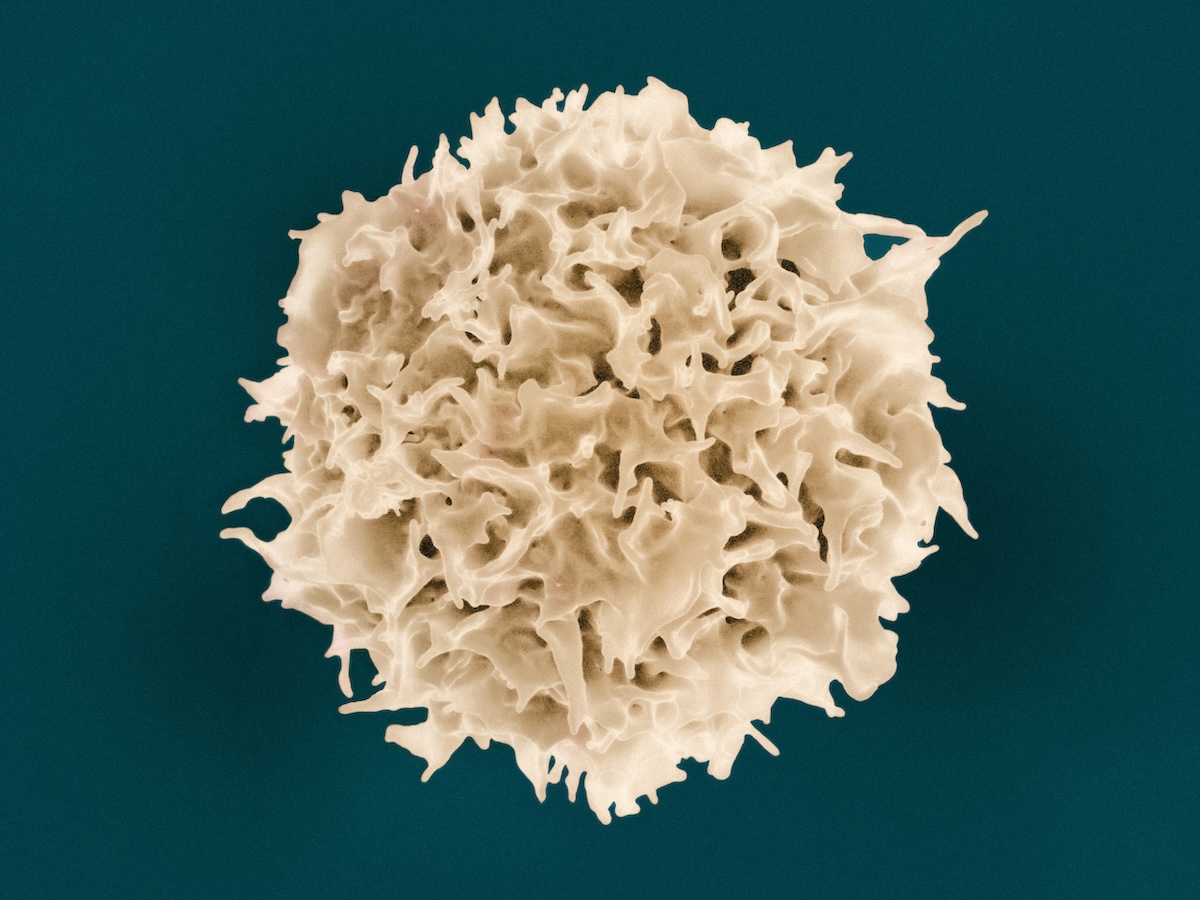 Graphic representation of a human T cell: Non-Hispanic Caribbean countries have the highest HTLV-1 infection rates outside Japan, sub-Saharan Africa, and South America | Image: Unsplash
A study published in JAMA Oncology in April 2026 found that immigrants from the non-Hispanic Caribbean have an incidence of adult T-cell leukemia/lymphoma (ATLL) approximately 32 times higher than that of people born in the US and Canada. The findings arise from the largest population-based analysis of the disease ever conducted in the United States. ATLL is a rare and aggressive blood cancer caused by the HTLV-1 virus.
The study drew on cancer registry data from all 50 US states. To assess the influence of birth country, the researchers focused on 13 states with complete information on patients’ origins. In total, they identified 3,228 cases diagnosed between 2005 and 2022.
Among non-Hispanic Caribbean immigrants, the incidence reached 14.1 new cases per million people—comparable to rates reported in historically endemic regions such as Japan, sub-Saharan Africa, and parts of South America. The highest rate was observed among people born in Grenada, at 33.7 cases per million. By contrast, among individuals born in the United States and Canada, the incidence was just 0.4 cases per million.
Racial disparities in survival rates
The five-year survival rate was calculated using data from New York and Florida—the only states with complete follow-up information—and averaged 23.8%. Survival varied substantially by race, ethnicity, and place of birth:
- Non-Hispanic Whites: 38.9%
- Hispanics: 26.1%
- US-born non-Hispanic Blacks: 19.6%
- Caribbean-born non-Hispanic Blacks: 14.5%
The disparity is not merely statistical. The analysis showed that non-Hispanic Black individuals born in the Caribbean face more than twice the risk of dying specifically from ATLL compared with non-Hispanic White individuals—a gap that persists even after accounting for factors such as age, gender, and disease subtype at diagnosis.
Since 2000, more than 300,000 babies have been born to mothers of Caribbean origin in Florida alone without any systematic screening for HTLV-1. According to the authors, this represents the largest missed opportunity for primary cancer prevention in the US.
Latent virus, late cancer
ATLL almost always begins the same way: a baby becomes infected during breastfeeding by a mother carrying the virus. HTLV-1 invades the body’s immune cells and remains dormant there—silent and symptom-free—for four to five decades, gradually accumulating genetic damage that, in a small fraction of cases, ultimately leads to cancer.
The disease typically emerges between the ages of 50 and 60. Only 2% to 5% of infected individuals develop ATLL.
Among adults, the virus can also be transmitted through sexual contact or blood exposure, much like HIV. The US Center for Disease Control and Prevention (CDC) recommends replacing breastfeeding with infant formula when maternal HTLV-1 infection has been confirmed. One important detail is that PrEP and other HIV-prevention strategies do not protect against HTLV-1, making maternal screening the only effective way to interrupt the chain of transmission that gives rise to the cancer.
Because it originates almost exclusively from infection acquired in early childhood, ATLL is, according to the authors, one of the few fundamentally preventable blood cancers.
The hidden problem: misdiagnosis
The disease’s invisibility has a second dimension. ATLL is frequently mistaken for other types of T-cell cancer, particularly peripheral T-cell lymphoma, not otherwise specified (PTCL-NOS), a category used when physicians are unable to identify a more specific subtype. The reason is straightforward: testing for HTLV-1 is not routinely performed when T-cell lymphoma is suspected, especially among patients from immigrant communities.
The researchers estimated the impact of this diagnostic confusion. After reclassifying cases likely to have been misdiagnosed, the incidence of ATLL among non-Hispanic Caribbean immigrants would rise from 14.1 to 22.7 cases per million—comparable to rates in southwestern Japan, historically the region most affected by the disease worldwide. Among people born in Grenada, the incidence could reach 59 cases per million, surpassing even that of Japan.
According to the authors, this is a preventable clinical failure. HTLV-1 testing should be routinely performed in all cases of T-cell lymphoma that lack a definitive subtype classification, particularly among patients originating from endemic regions.
Japan as a prevention model
Japan has demonstrated that the disease can be reduced. For more than three decades, the country screened pregnant women for HTLV-1 and advised infected mothers not to breastfeed. The results took time to emerge, but they eventually did: starting in 2013, the number of new ATLL cases started to decline in Kagoshima, one of the regions most heavily affected by the disease.
The United States has yet to follow that path. HTLV-1 testing is performed only for blood donations, not as part of prenatal screening. The authors propose a practical alternative: rather than screening the entire population—which would likely be less cost-effective given the virus’s low overall prevalence in the country—they recommend focusing on mothers born in non-Hispanic Caribbean nations, where the risk is demonstrably high.
The need for action is urgent. Children infected during the 1990s and 2000s are now entering the age range at which ATLL typically develops. Without intervention, the number of cases is expected to continue rising.
Brazil: silent endemic
Brazil tests for HTLV-1 in blood donors and pregnant women, but coverage remains insufficient. The disease is likely more common than official figures suggest, simply because so few cases are ultimately diagnosed. An abstract presented at the 2025 Brazilian Congress of Hematology, based on data from Rio de Janeiro’s Gaffrée and Guinle University Hospital (HUGG/UNIRIO), identified only six confirmed cases of ATLL over a ten-year period at a referral outpatient clinic in the city. All of the patients were women, with a mean age of 58, and they survived an average of just 13 months after diagnosis—far worse than the 23.8% five-year survival rate reported in the United States, where the disease is at least more likely to be recognized.
High HTLV-1 prevalence has already been documented in regions with large Black populations, such as Salvador, a pattern partly explained by the African ancestry of a portion of the population, as Central and West Africa have long been recognized as endemic regions for HTLV-1.
How Does HTLV-1 Cause ATLL?
-
1. Mother-to-child transmission
-
The primary route of infection is through breastfeeding, when an infant is exposed to the breast milk of a mother carrying the virus. This is by far the main pathway leading to the development of ATLL decades later.
-
2. Infection of immune cells
-
HTLV-1 targets a specific type of immune cell—CD4+ T cells—and establishes a permanent infection within them, without causing immediate symptoms.
-
3. Decades of latency
-
The virus can remain dormant for 40 to 60 years, gradually inflicting genetic damage on infected cells. During this period, individuals are typically unaware that they are infected and experience no symptoms.
-
4. Cancer development
-
In 2% to 5% of infected individuals, the cumulative damage eventually triggers cancer, usually between the ages of 50 and 60. The most aggressive form, known as the lymphoma subtype, is particularly common in Caribbean and African populations.
-
5. Frequent misdiagnosis
-
Because HTLV-1 testing is not routinely performed, physicians often classify ATLL as another type of T-cell lymphoma. Researchers estimate that roughly one-third of cases in the US may go undiagnosed or be assigned an incorrect diagnosis.
-
6. Adult transmission
-
In addition to mother-to-child transmission, the virus can spread through unprotected sexual contact and through unscreened blood transfusions. HIV-prevention strategies—including PrEP—do not provide protection against HTLV-1.
*
This article may be republished online under the CC-BY-NC-ND Creative Commons license.
The text must not be edited and the author(s) and source (Science Arena) must be credited.