 #News
#News
#News
28.04.2026
Unfinished buildings in China increase carbon emissions and health risks, study finds
Study estimates waste of 485 million tons of materials, a 9.6% increase in the sector’s carbon intensity, and 2.6 million years of life lost to disability associated with China’s real estate crisis
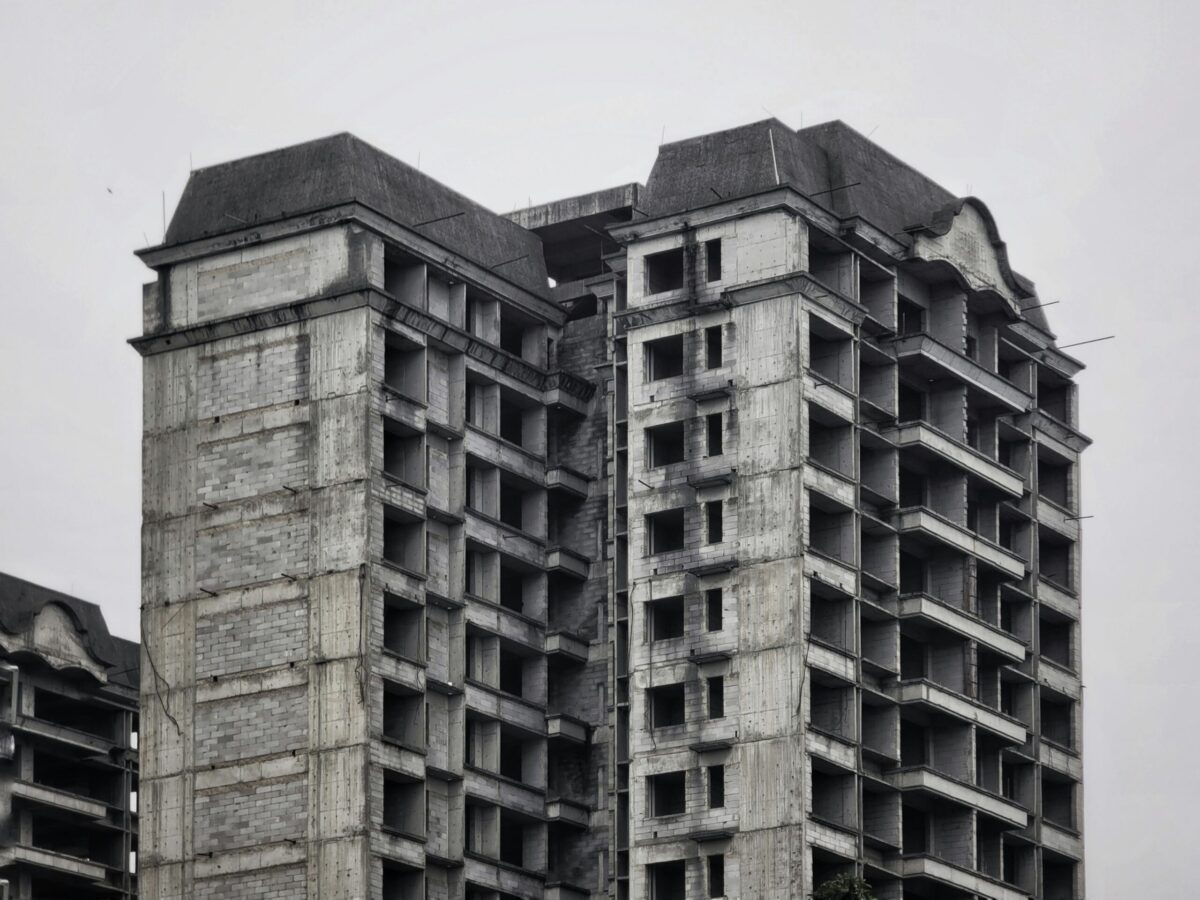 Unfinished buildings are no longer merely symbols of economic slowdown, but also sources of pollution, inefficiency, and risks to public health | Image: Wayee Tan/Unsplash
China’s real estate crisis has consequences that go beyond financial collapse: the unfinished buildings accumulating across the country have become obsolete assets—unable to serve their intended residential purpose while imposing substantial environmental and public health costs. These projects provide no functional benefit, delivering neither housing nor economic use.
A study published in the journal One Earth, conducted by researchers from China, the United States, Germany, the United Kingdom, and Australia, analyzed the volume of stalled construction projects in recent years and estimated the waste associated with these developments. The findings quantify a problem of considerable scale.
What are DALYs?
-
Meaning:
-
DALY stands for Disability-Adjusted Life Year.
-
Purpose:
-
It is a public health metric used to quantify the impact of diseases, injuries, and risk factors on populations.
-
Metric:
-
One DALY represents the loss of one year of healthy life, either due to premature death or to living with a disability or chronic condition.
-
Comparison:
-
The metric enables comparisons across different health conditions using a common unit, supporting public policy evaluation and the allocation of health resources.
-
Pollution leads to health losses:
-
In the study of China’s real estate crisis, the estimated 2.6 million DALYs reflect the impact of air pollution generated by stalled construction projects on the health of surrounding populations.
Materials consumed, benefits unrealized
According to the authors, 485 million tons of materials—such as cement and steel, as well as energy—were consumed in unfinished construction projects, resulting in intensive resource use without a proportional social return.
This process directly contributes to a 9.6% increase in the carbon intensity of the construction sector, which is already recognized as one of the largest global sources of greenhouse gas emissions.
The climate impact, the researchers note, occurs regardless of whether the projects are completed or not.
Health at risk
But the effects are not limited to climate: the study indicates that the waste of materials and energy is associated with deteriorating air quality, a well-established risk factor for cardiovascular and respiratory diseases. The research estimates 2.6 million DALYs (Disability-Adjusted Life Years) linked to pollution generated by stalled construction projects.
The presence of abandoned construction sites in urban areas tends to exacerbate already fragile conditions, contributing to degradation of the built environment, safety concerns, and socioeconomic stress among affected populations. The situation represents approximately US$347 billion (R$ 1.7 trillion) in economic losses.
Unfinished projects are concentrated in newly developed suburbs, amplifying inequalities and the lack of urban services.
How researchers measured the impact
To produce these estimates, the researchers combined data on real estate activity, material consumption and sectoral emissions, considering both the construction lifecycle and the indirect impacts resulting from the interruption of construction work.
This approach made it possible to assess not only the physical waste, but also its environmental and social consequences over time.
The study argues that China’s real estate crisis reveals a broader structural issue: urban development models disconnected from sustainable planning and economic stability tend to generate significant environmental and social consequences.
Unfinished buildings are no longer merely symbols of economic slowdown—they function as sources of pollution, inefficiency, and risks to public health, highlighting the need to rethink development models in the sector.
*
This article may be republished online under the CC-BY-NC-ND Creative Commons license.
The text must not be edited and the author(s) and source (Science Arena) must be credited.