#Vídeos
10.07.2026
How researchers can become entrepreneurs and innovators
Learn which skills researchers need to transform science discoveries into products, services, and solutions
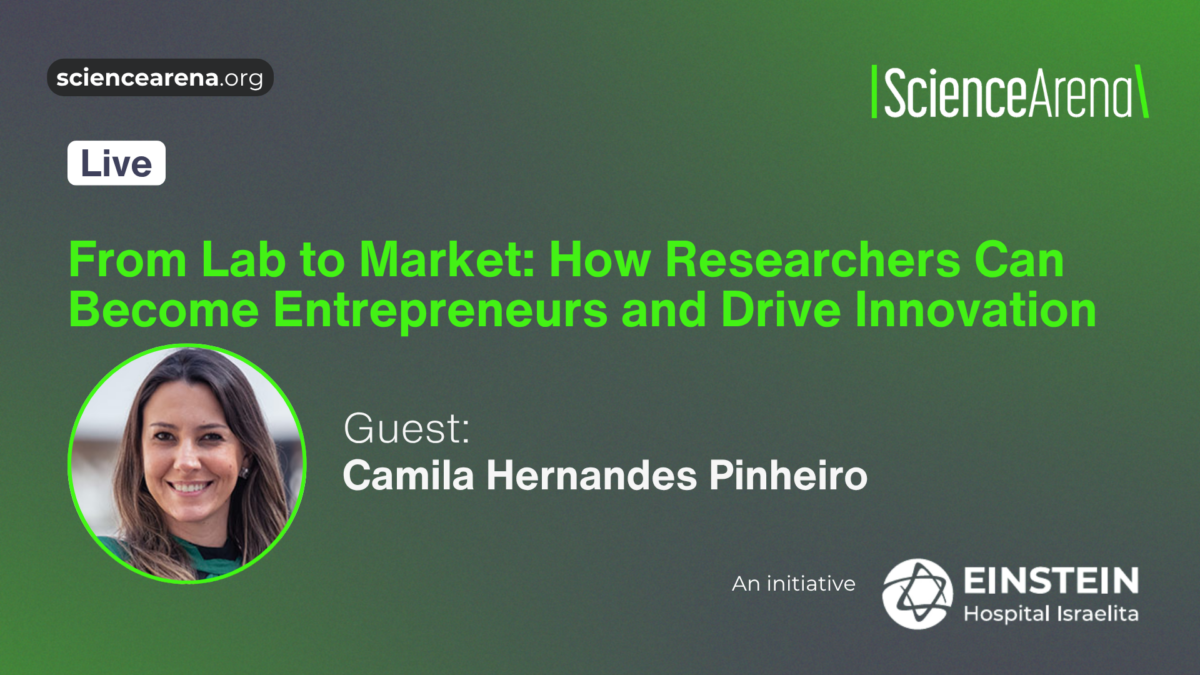
How can researchers become entrepreneurs and innovators? According to Camila Hernandes Pinheiro, Head of Collaborations and New Business at Einstein Israelita Hospital, the first step is a shift in mindset: rather than becoming attached to a particular solution, researchers should focus on the problem they are trying to solve.
This was the central message of a recent Science Arena discussion, with the full episode now available on YouTube.
[Please note: This video was originally produced in Portuguese. To watch it with English subtitles, enable YouTube’s automatically translated captions in the video settings.]
With both a master’s degree and a PhD in biotechnology, Hernandes describes how her own career evolved from academic research into innovation without leaving scientific research behind.
After joining Einstein as a postdoctoral researcher, she began evaluating technologies developed by startups as a scientific consultant.
The experience showed her that, beyond determining whether a solution is scientifically sound, it is equally important to examine whether it addresses a genuine healthcare need, how it will reach the market, and how many people it could ultimately benefit.
Throughout the discussion, Hernandes shares several recommendations for researchers interested in innovation and entrepreneurship:
- Focus on the problem—not the solution. Innovation requires a willingness to pivot. If you learn that someone has already developed a similar solution, the challenge is to determine how yours can be better or different. Your primary commitment should always be to solving the underlying problem.
- Validate your hypotheses beyond the scientific literature. Reviewing the scientific literature and searching patent databases are important, but they are only a first step. Hernandes recommends speaking with subject-matter experts and potential end users to determine whether the problem is truly relevant and what is still lacking to solve it.
- Learn about intellectual property, regulation and the market. Researchers looking to translate science output into products need to know when to seek protection for an invention, what regulatory pathway a new technology must navigate, how it can be produced at scale, and whether it is viable.
- Identify your competitive advantage before launching a venture. Great scientific ideas don’t always emerge in a vacuum. Researchers need to understand existing market solutions and define what makes their technology different. In fields such as biotechnology, a robust patent strategy can also be vital.
- Don’t try to do everything yourself. Hernandes notes that in Brazil, scientist-founders will often take on multiple roles all at once, including scientific, commercial, regulatory, and fundraising activities. As a venture matures, however, building a team with complementary expertise can accelerate your startup’s growth.
- Leverage the resilience you’ve developed as a researcher. Failed experiments, revised hypotheses, and course corrections are all part of a researcher’s development—and they are equally common in entrepreneurship. Startups often need to pivot, changing direction multiple times before arriving at a viable solution.
- Don’t view entrepreneurship as a departure from science. A research project may result in a patent licensed to an established company. A researcher may found a startup, serve as an advisor, or continue an academic career. There are many ways to help transform scientific discoveries into innovation.
- Understand the entrepreneurial journey before taking the plunge. For researchers curious about entrepreneurship, Hernandes’ most practical piece of advice is to explore the ecosystem gradually: attend events, network with researchers who have made the transition, and learn what day-to-day life is really like for startup founders. “It doesn’t have to be a sudden break,” she says.
Her strongest recommendation for anyone considering entrepreneurship is to seek out people who have already taken that path.
According to Hernandes, entrepreneurship comes with setbacks and plenty of closed doors, but also constant learning.
Understanding this helps researchers decide how much they are willing to invest in the journey.
Visit the Science Arena video library to discover more episodes.
*
This article may be republished online under the CC-BY-NC-ND Creative Commons license.
The text must not be edited and the author(s) and source (Science Arena) must be credited.
Videos