#Videos
22.05.2026
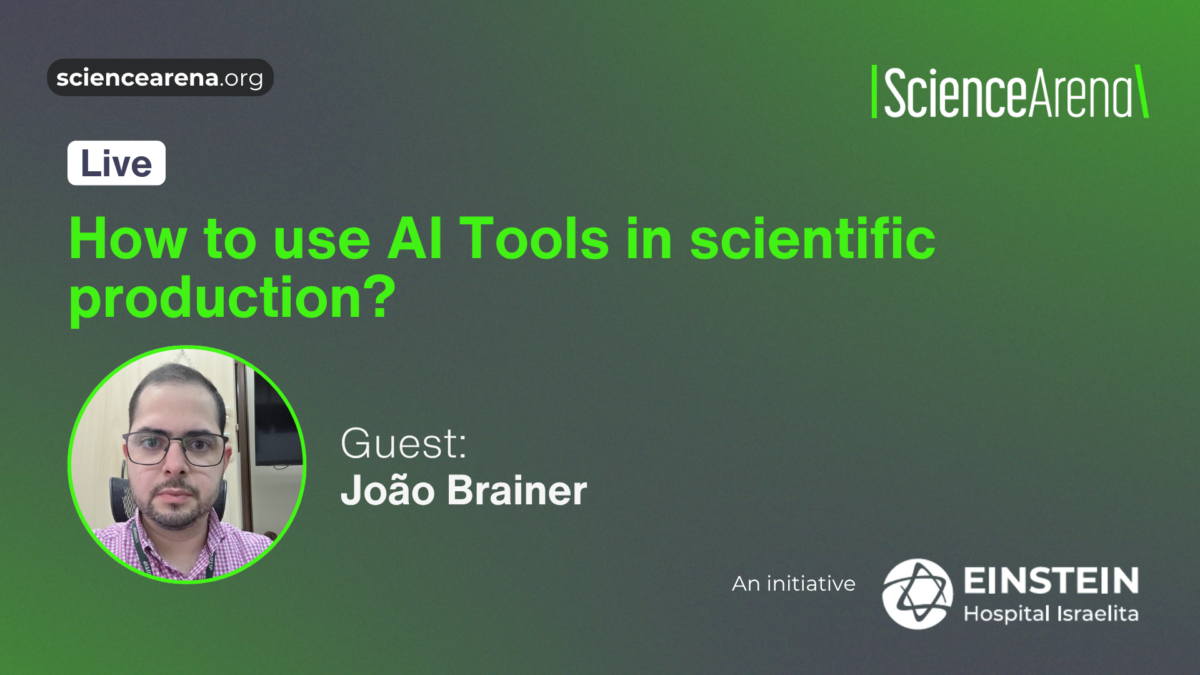
How to use AI tools in scientific production
Find out which artificial intelligence tools are best suited to each stage of drafting a scientific paper
The use of artificial intelligence (AI) is part of everyday life for many researchers and graduate students. But with so many platforms now available, one question keeps coming up: How do you choose the right tool for each stage of the research process?
This was the focus of a virtual event hosted by Science Arena in late April, featuring neurologist João Brainer, a clinical researcher at Einstein Hospital Israelita and professor at the Federal University of São Paulo (UNIFESP). The conversation was moderated by Science Arena’s editor-in-chief, Bruno de Pierro.
During the discussion, Brainer explained how AI can support tasks such as literature review, reference management, manuscript structuring, data analysis, and academic writing. The goal was to offer a practical starting point for researchers wishing to use AI tools more effectively without sacrificing scientific rigor.
The conversation covered platforms such as Consensus, CORE, Open Evidence, SciSpace, Perplexity AI, and large language models such as ChatGPT, Claude, and Gemini.
Each one, Brainer pointed out, has its own specific functions, strengths, and weaknesses—and none of them should be seen as a single solution for the entire research process.
One of the key points discussed was the need to use different tools for literature searches, reading, summarization, and reference management.
Brainer also warned of the risks, such as AI hallucinations, loss of originality in writing, biases in AI responses, and privacy issues, especially when researchers are working with sensitive data, patents, or unpublished ideas.
Rather than debating whether or not AI should be used in science, the event underscored that the challenge now is learning how to use it strategically, critically, and responsibly. Click here to watch the full discussion.
Online discussions about scientific careers
Launched in 2025, the Science Arena Encontros series addresses current and future issues in scientific careers.
Encontros is aimed at undergraduate students, faculty, graduate students, postdoctoral researchers, and administrators working in public and private research institutions.
Science Arena (sciencearena.org) is a non-profit science journalism initiative aimed at researchers, launched by Einstein Hospital Israelita in 2024.
Visit the Science Arena video section to access all episodes.
*
This article may be republished online under the CC-BY-NC-ND Creative Commons license.
The text must not be edited and the author(s) and source (Science Arena) must be credited.
Videos