 #Careers
#Careers
12.05.2026
Brazil trains PhDs, but fails to absorb them: Data reveal brain drain and structural bottlenecks
An OECD report mapping scientific careers across 53 countries shows that Brazil employs just 2.8 PhDs per thousand workers—four times below the international average
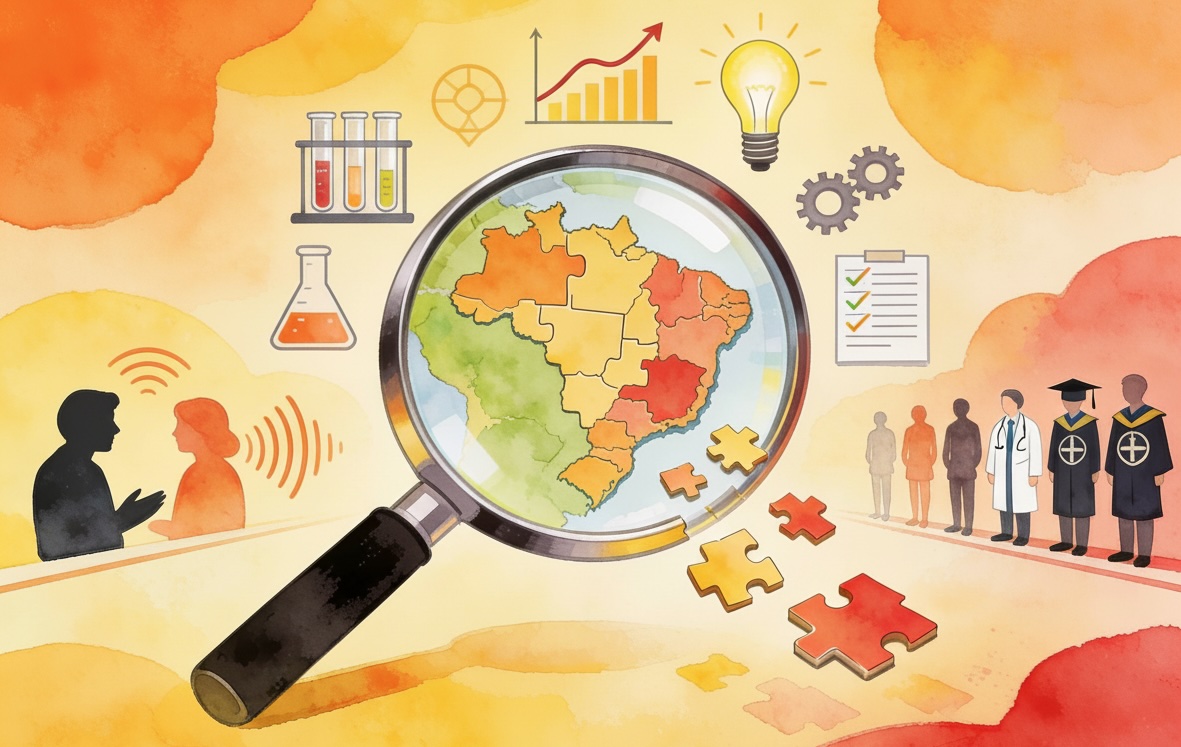 OECD data show that Brazil trains PhDs but fails to absorb them into the job market | AI-generated image
The path that has for decades defined a scientific career—from graduate school to postdoctoral research and, ultimately, to a university position—no longer reflects the trajectory of most researchers. Faced with budget cuts, a shortage of permanent positions, and growing pressure to deliver results, an increasing number of scientists are seeking careers in research outside academia: for example, in science-based startups, civil society organizations, and sectors once considered peripheral to knowledge production.
This trend, observed across multiple countries, has come into sharper focus through analyses by the Research and Innovation Careers Observatory (ReICO), a joint initiative of the Organization for Economic Cooperation and Development (OECD) and the European Commission.
In Brazil’s case, the data reveal a troubling picture: the country loses 1.36% of its scientific authors to other countries, the third-highest net outflow rate in Latin America.
What is ReICO and why does it matter?
ReICO functions as a dynamic information hub on careers in research and innovation. Launched in June 2025 after six years of development, the observatory brings together interactive dashboards, downloadable visualizations, open-access databases, and a mix of official and experimental statistics from 53 countries.
The goal is to support evidence-based decision-making by policymakers, research institutions, and researchers themselves.
The initiative responds to two converging demands: a recommendation by the Council of the European Union to create a European framework for attracting and retaining talent in research and entrepreneurship, and the OECD’s 2024 Ministerial Declaration on Transformative STI Policies, which explicitly called for tools to monitor inclusion, mobility, and conditions in scientific careers.
In an interview with Science Arena, Fernando Galindo, principal economist at the OECD Directorate for Science, Technology, and Innovation and head of ReICO, explained that the initiative aims to address multiple gaps in knowledge and evidence regarding the characteristics of careers in research and innovation. “All of this from an international perspective, learning from previous initiatives that failed to achieve critical mass.”
The platform is organized around three thematic pillars—talent development, the research and development (R&D) labor market, and researcher mobility—and covers issues ranging from the professional aspirations of 15-year-olds to the employment conditions of senior researchers.
Of the 53 participating countries, 45 have already appointed national contact points to coordinate data submission; Brazil is one of them.
What ReICO data reveal about Brazil
-
Academic progression
-
Thirty-nine percent of Brazilian master’s graduates go on to pursue a PhD, compared with an OECD average of 9.6%, but this progression does not translate into a higher density of PhDs in the economy.
-
Density of PhDs
-
Brazil has 2.8 PhDs per thousand workers, compared with an OECD average of 12, and 33.2 in Switzerland, the leading country on this indicator.
-
Net flow of scientific authors
-
At -1.36%, Brazil has the third-highest outflow of researchers among Latin American countries, behind Colombia and Peru.
-
Participation in STEM
-
Only 10% of Brazilian PhDs work in Science, Technology, Engineering, and Mathematics (STEM), compared with an OECD average of 50%.
-
Youth Aspirations
-
Some 9.7% of Brazilian students aged 15 to 16 say they want to work in science or engineering, a proportion close to the OECD average (10.7%), but there are no longitudinal data to determine whether those aspirations ultimately materialize.
The Brazilian picture: advanced training, weak absorption
Three indicators available in the ReICO report paint a consistent picture of Brazilian science when analyzed together.
The first concerns academic progression: 39% of Brazilian master’s graduates go on to pursue a PhD, a proportion significantly higher than the OECD average of 9.6%.
Between 2017 and 2022, this transition increased by 3.7%, indicating recent improvement. That progress, however, has not translated into a greater presence of PhDs in the economy.
The second indicator reveals this structural limitation: Brazil has 2.8 PhDs per thousand workers, far below the OECD average (12 per thousand) and the European Union average (11.2 per thousand).
In countries with a higher incorporation of highly qualified professionals, the gap is even wider: Switzerland has 33.2 PhDs per thousand workers; Slovenia, 27.5; and Luxembourg, 26.6. Although a relatively large share of Brazilian master’s graduates goes on to doctoral studies, the job market absorbs very few of these professionals.
The third indicator completes the picture: Brazil has a net outflow rate of scientific authors of -1.36%, meaning the country lost approximately 1.36% of its scientific workforce to other countries during the period analyzed.
Within Latin America, Brazil ranks third in net outflow, behind Colombia and Peru. Globally, the largest inflows of researchers are concentrated in Luxembourg, Saudi Arabia, and Switzerland, while the largest outflows are found in South Africa, Argentina, and Brazil.
Galindo stresses that this movement must be interpreted with caution, since the indicator tracks changes in institutional affiliation over time and does not automatically imply a “brain drain,” as researcher mobility may include temporary periods abroad, returns, and reintegration.
Even so, the three indicators together point to a cycle of fragility: Brazil produces relatively few PhDs relative to its workforce; those who graduate struggle to find positions commensurate with their qualifications; and a significant share move abroad.
“In Brazil, only 10% of PhDs work in STEM sectors, corresponding to around 4,600 professionals, compared with an OECD average of 50%,” says Fernando Galindo, principal economist at the OECD.
Chronic underutilization: what national data confirm
For Daniel Colombo, a researcher at the Institute of Applied Economic Research (IPEA), ReICO fills a critical gap by providing internationally comparable data.
“Although the country has solid databases—from CAPES to RAIS (Annual Social Information Report)—there was no platform capable of connecting this information to global trends,” he says.
Studies conducted by Colombo at IPEA provide a more detailed picture: around 85% of PhDs employed in the private sector outside education occupy positions considered incompatible with doctoral-level training—that is, jobs for which a PhD is not required to perform the role.
This reflects a mismatch between educational attainment and the formal requirements of the occupation, a clear sign of skill underutilization.
In an analysis of the evolution of this indicator between 2010 and 2021, Colombo found that the share of PhDs in incompatible occupations increased over the period among those employed in the private sector outside education, suggesting worsening labor-market absorption conditions.
The so-called doctoral “wage premium,” calculated using an econometric model, is just 8.7% in the non-educational private sector and 1.1% in the private education sector. Comparisons with developed countries are revealing: in Germany, the estimated figure is 26.8% relative to individuals with a master’s degree; in Finland, 31%.
Colombo argues that addressing this situation requires structural and cultural changes: “Public policies capable of integrating universities, companies, and government, along with valuing multiple career paths, are essential to prevent the country from continuing to train scientists who cannot find space to fully apply their skills. It is crucial to combat the culture that associates success exclusively with academic careers.”
The researcher notes that these difficulties have been recognized by the agencies responsible for graduate education. Brazil’s 2025–2029 National Graduate Education Plan (PNPG) acknowledges that expansion of the system has not been accompanied, to the same extent, by increased employability among graduates, and that the absorption of master’s and PhD graduates remains concentrated primarily in science and technology institutions, government agencies, and state-controlled companies.
How CAPES and CNPq are responding to this scenario

For Antônio Gomes, director of Graduate Evaluation at CAPES, Brazil has an important institutional advantage: the Sucupira Platform. “It is an evaluation and data collection system that many countries do not have,” he states.
According to Gomes, the system already makes it possible to track graduates of master’s and PhD programs and is expected to be organized more systematically in the near future. “For CAPES today, the priority is graduate-program alumni.”
In his view, transforming the landscape of scientific careers will require expanding partnerships with companies and creating engagement ecosystems that connect graduate education to the country’s strategic demands, bringing researcher training closer to the non-academic job market.
At Brazil’s National Council for Scientific and Technological Development (CNPq), the perspective is complementary. Dalila Andrade, from the agency’s Directorate for Institutional, International, and Innovation Cooperation, explains that data from the Lattes Platform and the Sucupira Platform are cross-referenced with the Annual Social Information Report from Brazil’s Ministry of Labor and Employment to track the career paths of graduates outside academia. “If they did not pursue an academic career, we can identify where they went,” she explains.
This cross-referencing of data supports studies such as a report by the Center for Management and Strategic Studies (CGEE) on PhD graduates employed in Brazil, which highlights a troubling pattern: most master’s and PhD graduates are concentrated in education, particularly in the public sector, while relatively few are employed in industry and the private sector.
For Dalila Andrade, this situation requires the business sector to become more aware of the importance of integrating highly qualified researchers into the workforce.
“We emphasize that the responsibility for keeping researchers in Brazil does not lie solely with funding agencies, but also with the institutions that employ them. This is not a challenge faced only by CNPq, but by Brazil as a whole,” explains Dalila Andrade, director of institutional cooperation at CNPq.
Among CNPq’s recent initiatives aimed at addressing the problem are the Knowledge Brazil Program, which offers scholarships worth R$13,000 per month—the highest amount ever paid by the agency—and the Program for the Retention of PhDs (PROFIX), which provides the same amount and focuses on retaining talent within the country.
PROFIX operates in partnership with state-level Research Support Foundations (FAPs), which provide additional support through research funding and undergraduate research scholarships.
Existing initiatives and remaining gaps
The OECD report recommends closer integration between academia and the private sector, greater recognition of diverse career paths, and incentives for intersectoral and international mobility.
Some Brazilian initiatives already point in this direction. The Training Program for Human Resources in Strategic Areas (RHAE) encourages innovative companies to hire researchers; the Innovative Research in Small Businesses Program (PIPE), run by the São Paulo Research Foundation (FAPESP), funds research in micro and small businesses; and CAPES has been adjusting its evaluation system to take into account the career paths of graduates outside academia.
Even so, disparities persist. The unequal distribution of research infrastructure and opportunities deepens regional inequalities, particularly in northern Brazil, in STEM fields, and among historically underrepresented groups.
The precariousness associated with postdoctoral fellowships and temporary contracts also reflects global trends, but in Brazil’s case it occurs without the institutional safeguards observed in countries that have already diversified and stabilized their scientific career structures.
Galindo, from the OECD, notes that ReICO does not include projections about the future: “Data on talent development help provide an indication of the future supply of research talent, but not future demand. Indicators on age distribution and dependence on internationally mobile talent also provide insight into possible future challenges for countries.”
The observatory therefore does not offer ready-made answers, but rather a map. Brazil’s challenge is to use it to transform data, talent, and policies into a genuine ecosystem of innovation and opportunity—before more researchers decide to pursue their careers elsewhere.
*
This article may be republished online under the CC-BY-NC-ND Creative Commons license.
The text must not be edited and the author(s) and source (Science Arena) must be credited.