 #Interviews
#Interviews
15.04.2026
Hugo Aguilaniu: “Without scientific philanthropy, Brazil is giving up on risk.”
Serrapilheira Institute director assesses Brazil’s research funding system and links risk aversion to the absence of a Brazilian Nobel laureate
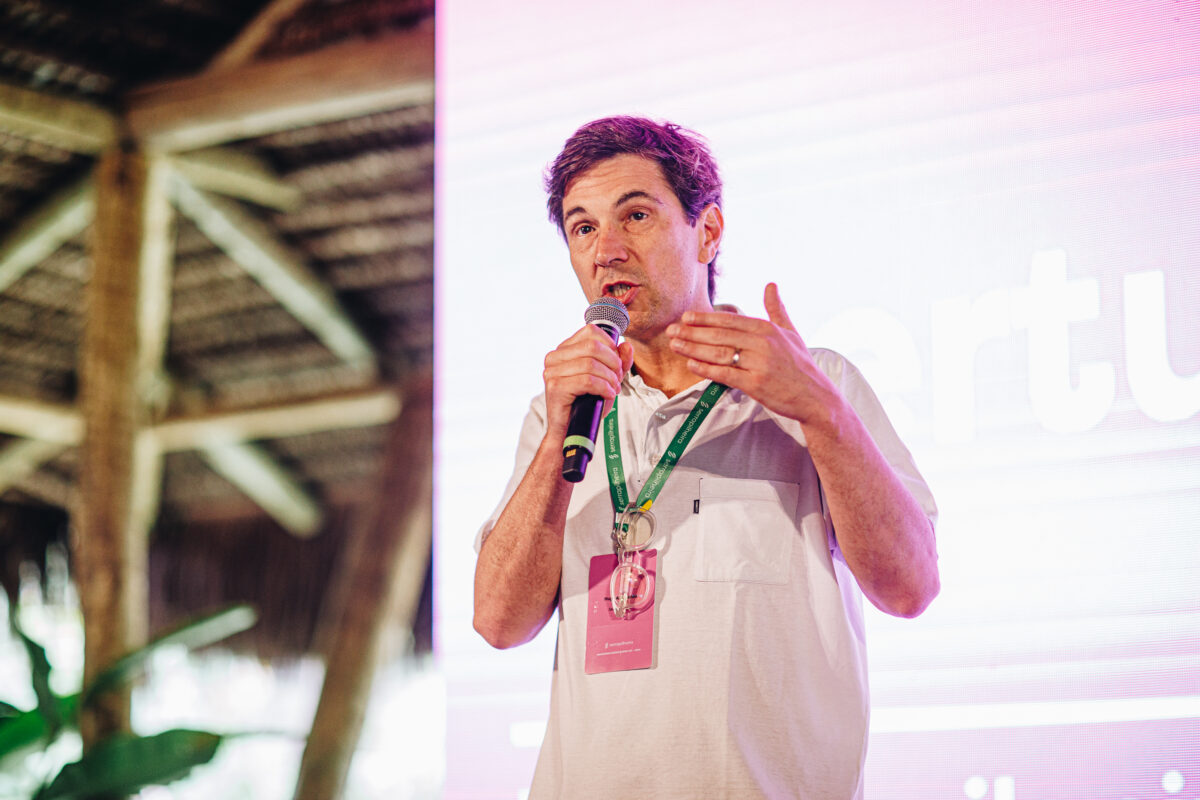
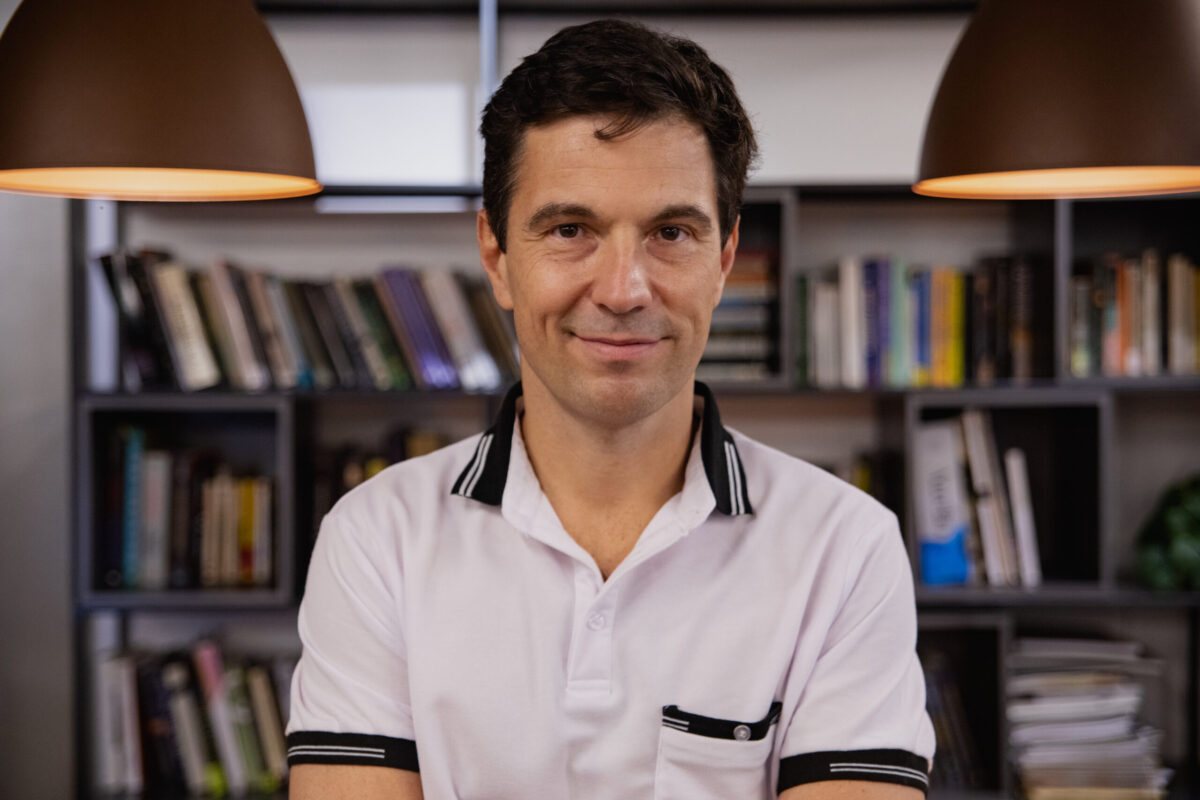 For Hugo Aguilaniu, imposing obstacles to scientific philanthropy means giving up on risk—and perhaps the Nobel Prize, says the Serrapilheira Institute director | Image: Serrapilheira Institute
“Imposing obstacles to philanthropy means giving up on risk.” These are the words of Hugo Aguilaniu, director of the Serrapilheira Institute, the first philanthropic organization in Brazil dedicated to basic science, summarizing his diagnosis of the country’s scientific funding system.
Born in Grenoble, France, Aguilaniu trained as a molecular geneticist in Sweden and previously worked at the Salk Institute in the United States. In 2006, he joined France’s National Center for Scientific Research (CNRS), where he became scientific director in 2011.
He moved to Brazil in 2017 to lead the Serrapilheira Institute. Since then, he has been backing researchers with ideas that, as he puts it, “need to be bold, but not crazy.”
In his view, Brazil’s research funding system is solid, but it lacks a key ingredient behind many revolutionary discoveries: private capital willing to take chances on uncertain ideas—even those that may not succeed.
The consequence, he believes, may explain why no Brazilian has yet won a Nobel Prize.
In an interview with Science Arena, Aguilaniu talked about risk, creative freedom, and what he would say to himself at the beginning of his career.
Science Arena – What is your opinion on Brazil’s research funding system for early-career researchers?
Hugo Aguilaniu – The system is robust. State research foundations, together with the Brazilian Federal Agency for Support and Evaluation of Graduate Education (CAPES) and the Brazilian National Council for Scientific and Technological Development (CNPQ), create a solid institutional structure.
For researchers in training, it works well: the system provides funding for fellowships and allows for national and international mobility. The problem arises when a researcher becomes a new professor.
The system is biased towards established professors—a meritocracy that does not differentiate between someone who started two years ago and someone who has been working for 30 years.
This is beginning to change, with institutions like the São Paulo State Research Foundation (FAPESP) creating funding opportunities for young researchers. It has taken time, but things are changing.
How can the ideas of young researchers be channeled?
I do not know if we want them to be channeled—we want them to explode. In mathematics, the Fields Medal is only awarded to researchers under 40, recognizing that this is often the most creative phase of a person’s career. The system needs to fund both of these profiles.
And what about private funding and risk?
The Brazilian system does not encourage private investment. Public funding should remain public, but philanthropy promotes other ways of thinking. It is a pity that there are no tax incentives to support it.
Philanthropy is better suited to risk-taking—instead of spending public money, it uses the resources of people who knowingly accept the risk.
Historically, it is private sources that fund truly risky research. Imposing obstacles to philanthropy means giving up on risk. Maybe that is why Brazil has struggled to make groundbreaking discoveries—and to win a Nobel Prize.
Does that mean we need to change productivity metrics?
Yes. Current metrics are old and very quantitative, and there is a historical explanation for that. The system is about 60–70 years old, and in the early days, it needed to prove output.
It worked: the quantity of scientific papers increased. Now, Brazil needs to improve quality. Philanthropy can challenge the system with more adventurous criteria.
How can we solve the problem of postdoctoral researchers without positions?
There are two main problems. The first is scale: Brazil educates far more people than the university system can absorb. The second is recognition: having a PhD often does not lead to significantly better prospects.
In Germany, a PhD holder enters the private sector at a senior level. That recognition does not exist here—and researchers are not being informed about other pathways.
When we ask young PhD holders what they want to be, the answer is almost unanimous: “a university professor.” When we ask them what happens if they do not achieve that aim, most do not know.
What are the requirements to secure funding for a bold idea?
I can only speak for the Serrapilheira Institute. We look for conceptual courage: bold ideas, but not crazy ones. At every stage there is a tendency towards conservatism, and our job is to push back against that.
The idea needs to be very good, and the researcher needs to explain why they want to do something that no one has done before. Brazil has many underutilized assets: the Brazilian Center for Research in Energy and Materials (CNPEM) has Sirius, a particle accelerator available to any Brazilian researcher, but very few are making use of it.
It will soon have a state-of-the-art biosafety laboratory attached—something unique worldwide. Limited preliminary data are not the problem; weak ideas are.
What advice would you give yourself at the start of your career?
Two things. First, read more. Having a broader knowledge of the field would have made me more creative. I always felt that the most interesting ideas lay at the boundaries between fields; greater knowledge would have transformed that intuition into something more powerful.
And secondly, be more independent. Students in Brazil rely too much on a single advisor. They should be in control of their own education, explore various laboratories, and choose their own paths.
Giving them freedom from an early age is key to Brazil’s next great achievement—and that starts before they earn their PhD.
*
This article may be republished online under the CC-BY-NC-ND Creative Commons license.
The text must not be edited and the author(s) and source (Science Arena) must be credited.