 #News
#News
#News
17.06.2026
Pulmonary fibrosis: AI-developed drug shows promising early results
Clinical trial indicates improvement in a measure of lung function, but safety, efficacy, and use with other populations still need to be confirmed
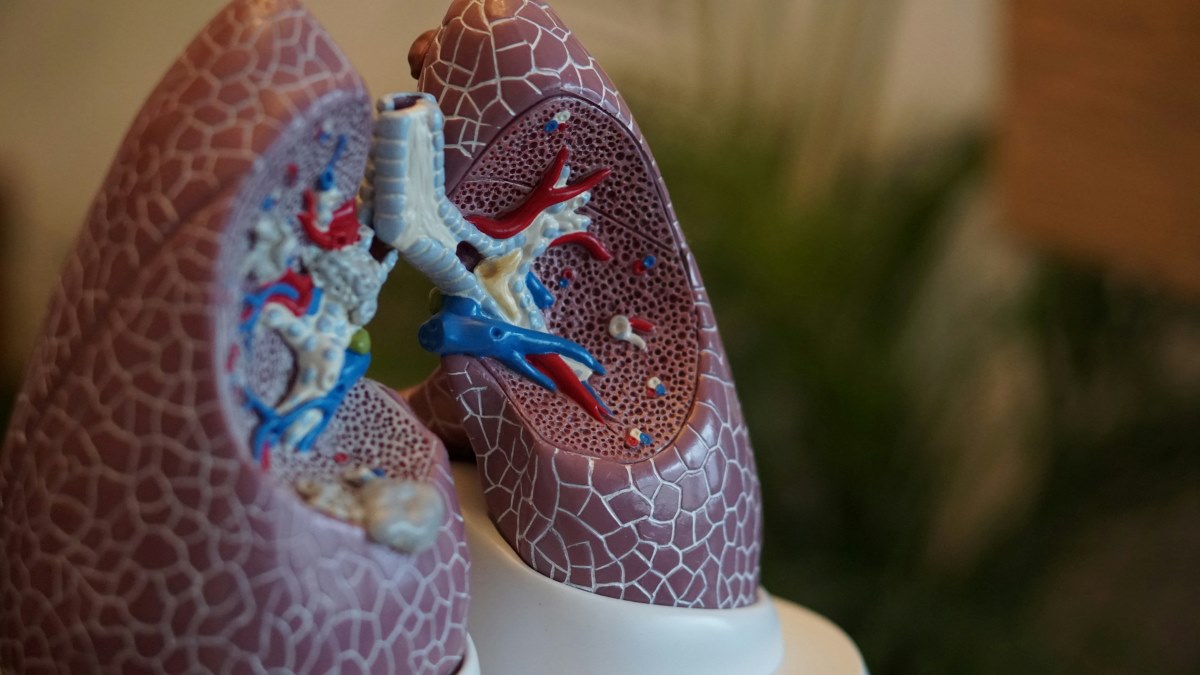 Anatomical model of human lungs: a phase 2 study of rentosertib highlights the potential of artificial intelligence in the development of new drugs for idiopathic pulmonary fibrosis | Image: Unsplash
Idiopathic pulmonary fibrosis (IPF) has no cure. The lung tissue becomes progressively stiffened and scarred, lung function declines, and the only available medications, nintedanib and pirfenidone, merely slow this process.
Median survival after diagnosis is two to four years. Against this backdrop, researchers using artificial intelligence (AI), have reported an important clinical outcome in the development of novel therapeutics for the disease.
Rentosertib, developed with the aid of AI by Insilico Medicine, has yielded its first results in a controlled clinical trial. In a phase 2 study published in Nature Medicine, researchers at the company reported that patients treated with the drug showed an improvement in forced vital capacity—a measure of lung function—while the placebo group experienced a decline.
Among patients not taking other antifibrotic drugs at the same time, the improvement was even greater.
Science Arena asked Brazilian experts what they thought of the achievement.
Target identification and molecule generation
Insilico Medicine developed the drug in two stages: first, it analyzed large volumes of genomic data and scientific literature using PandaOmics, the company’s platform integrating genomic, proteomic, and scientific literature data to identify and prioritize therapeutic targets. The TNIK protein emerged from this analysis as an important target for IPF.
The company then computer-generated a molecule capable of inhibiting it, using generative models that produce and evaluate thousands of virtual compounds before any physical experimentation.
“Until recently, AI was more focused on finding molecules for already known targets,” explains Carolina Horta Andrade, associate professor at the Federal University of Goiás (UFG).
“Multimodal vision now allows the technology to also find or validate the target itself,” explains the researcher, who did not participate in the study.
ZINC, one of the databases used in drug discovery research, contains more than 200 million candidate molecules.
“AI identified which ones were more likely to become viable drugs before any physical experimentation,” explains Eduardo Habib, a researcher at the Federal Center for Technological Education of Minas Gerais (CEFET-MG).
For Andrade, the result is historic: “For the first time, they got both the biological target and the molecule right, all the way to clinical testing.” In other words, it was like discovering the key and the lock at the same time from a list of millions of possible combinations.
What usually takes two to three years in the initial phases of research was completed in less than two months.
What the phase 2a trial showed
The clinical trial was designed to assess safety. In secondary outcomes, patients treated with rentosertib showed an improvement in forced vital capacity, while the placebo group experienced a decline.
Among participants not taking other antifibrotic drugs at the same time, the effect was more pronounced, raising questions about possible interactions with treatments already approved for IPF.
“This new molecule needs to undergo the same testing as a non-AI generated one, and it may fail in later experimental testing,” notes biomedical scientist Leonardo Ferreira, professor at the São Carlos Physics Institute, University of São Paulo (USP).
The phase 2a results indicate a preliminary signal of efficacy, not an approval.
According to the research, seven patients discontinued treatment due to liver toxicity, four of whom were taking nintedanib. The study population comprised exclusively Asian participants, which limits the generalizability of the findings.
“This validation among other populations, including Brazilians, is not a luxury; it’s part of the scientific agenda,” says Andrade. The researcher also points out the opacity of the tool: “It is a closed system we call a ‘black box,’ and the scientific community is unable to verify the inner workings of the model.”
“The success of AI in drug design depends on the quality of the experimental data used to feed these computational algorithms,” says Ferreira, of USP.
In addition, neglected diseases—less researched and less profitable for the industry—generate little data, directly limiting the tool’s effectiveness.
The path to approval
The next stage of the study is the phase 3 trial, which will need to demonstrate efficacy and safety in larger populations. Historically, most drug candidates fail during the clinical phases.
Andrade recalls that the failure rate in phase 2 is similar to that observed in traditionally developed molecules: around 60%.
No drug developed with the aid of AI has ever completed phase 3 trials and obtained regulatory approval.
What has changed is the beginning of the pipeline: research time can be substantially reduced before a molecule is tested on humans.
“Regardless of an AI tool’s level of efficiency, you will still need a specialist overseeing it,” says Michel Pires, also a researcher at CEFET-MG.
“AI does not replace researchers, but it does change the way we work.” adds Habib. Ferreira further notes that the field requires multidisciplinary knowledge and an openness to understanding concepts across different disciplines, such as biomedicine, physics, and computer science.
It remains to be seen which molecule developed with the help of AI will be the first to successfully complete all phases of clinical trials and reach the market. Until then, they have nothing more than the potential to do so.
*
This article may be republished online under the CC-BY-NC-ND Creative Commons license.
The text must not be edited and the author(s) and source (Science Arena) must be credited.