 #Suggested Reading
#Suggested Reading
24.06.2026
When science turns on those who get it right
The Economist journalist Matt Kaplan explores why scientific paradigms are so resistant to change—and the price paid by researchers who dare challenge the consensus
 Resistance to ideas that challenge the consensus is rarely silent—it often comes with outrage, says Kaplan | Image: Unsplash
WHAT DO I RECOMMEND?
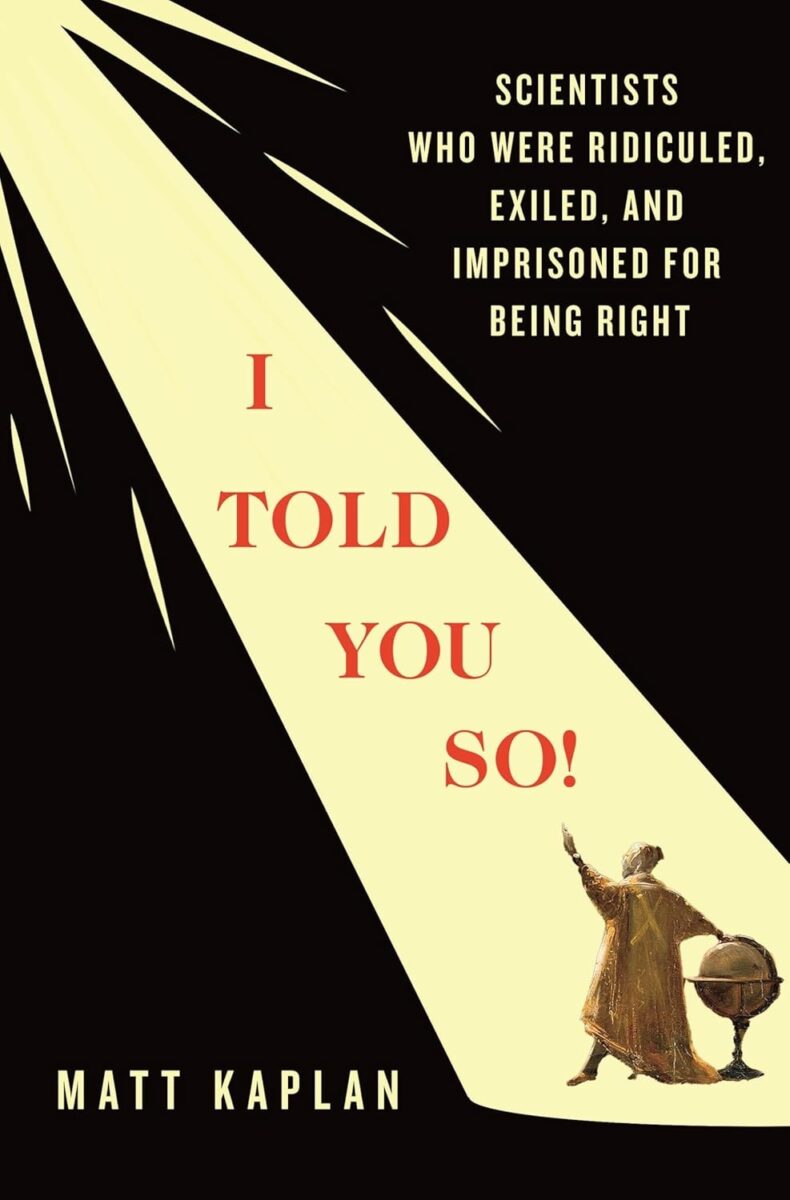
The book I Told You So: Scientists Who Were Ridiculed, Exiled, and Imprisoned for Being Right, published in 2024 by St. Martin’s Press and written by Matt Kaplan, science correspondent for The Economist and former paleontology researcher at the University of California, Berkeley (USA).
The book was based on dozens of interviews with active scientists and on the analysis of historical cases spanning four centuries of medicine, biology, and paleontology.
The text reconstructs what should be an elementary notion in the scientific world: that new data can overturn scientific consensus, and demonstrates case by case why this rarely happens without some personal cost to those who present the data.
WHY IS THIS BOOK RELEVANT?
I Told You So has historical ambition. Kaplan not only reports that scientists were persecuted: he diagnoses the mechanism. The central argument is that resistance to new ideas is not an occasional flaw in the scientific system, but a structural consequence of how paradigms are constructed, defended, and funded.
The case of Ignaz Semmelweis opens the book and anchors the entire argument. In 1847, the Hungarian physician demonstrated that doctors were transmitting postpartum infection (childbed fever) to women in labor by not washing their hands before deliveries.
Semmelweis was dismissed, forcibly committed to an asylum, and died without ever seeing his hypothesis accepted. What Kaplan shows is that the resistance to his work did not stem from ignorance: it came from physicians who fully understood what he was saying but could not accept that they themselves were the vectors of the disease.
The book also documents the case of Mary Schweitzer, a paleontologist who, in the 1990s, identified structures consistent with red blood cells in an 80-million-year-old fossilized Tyrannosaurus rex bone.
The discovery contradicted the claim that soft tissues could not survive fossilization. Schweitzer was attacked by colleagues for two decades. Only in 2017, after publishing results obtained under tightly controlled conditions, did the field begin to reconsider its position. She is now considered the founder of molecular paleontology.
The book also documents how institutional biases are perpetuated: funding denied to researchers who challenge the consensus, journals rejecting articles for personal reasons, and advisors instilling in students the same certainties that they themselves inherited.
“We inherit certain beliefs from our advisors,” paleontologist Johan Lindgren of Lund University tells the author. “And it is difficult to change this inherited mindset.”
WHAT MAKES THIS BOOK A MUST-READ?
There are two standout moments in the book: the first is the opening scene. In 2012, Kaplan witnessed a group of senior researchers surround PhD student Alison Moyer—one of Schweitzer’s students—and verbally attack her poster at a vertebrate paleontology conference.
She had questioned whether the structures identified as melanosomes in fossil feathers might actually be bacteria—a scientifically grounded idea. The field responded with fury. The scene is unsettling because Kaplan was there, with his press badge tucked inside his pocket, and he did not look away.
The second is the story of Alexander Gordon, a Scottish physician who, in 1795, almost half a century before Semmelweis, published detailed evidence that midwives and physicians were transmitting childbed fever from patient to patient. Gordon created tables listing names, dates, and chains of transmission.
He then published, along with the data, the names of the professionals he had identified as unwitting vectors. The population of Aberdeen turned against him. He fled to the Navy and died of tuberculosis at sea aged 47, without any of his conclusions being taken seriously.
The book is not pessimistic, nor does it offer easy consolation.
Kaplan concludes that understanding how science has failed in the past is the only way to make it fail less in the future, and that the gap between discovery and acceptance has tangible consequences, measured in lives that could have been saved.
*
This article may be republished online under the CC-BY-NC-ND Creative Commons license.
The text must not be edited and the author(s) and source (Science Arena) must be credited.